
· by Michael Blair, Nashville's Crawl Space Repair
Most of what we deal with under Middle Tennessee houses is water you can see or smell: damp joists, a musty floor, puddles after a hard rain. Radon is the opposite. It has no smell and leaves no stain, and it comes up out of the same dirt floor we spend our days covering. Searches for vapor intrusion and vapor mitigation systems around Nashville often start with a real estate report, a neighbor’s test result or a question from a doctor. Here is how radon moves through a crawl space, what the test tells you, and how crawl space encapsulation fits with a vent system when one is called for.
Can radon be a problem under a Nashville house?
It can be, and the only way to know for a given house is a test. The Metro Nashville Public Health Department’s radon information page says the EPA lists Davidson County as having a high potential for elevated radon, and that about 40 percent of the 4,152 homes tested in the county showed elevated levels. That is a count of homes that were tested, not a survey of every house, but it is a large share.
Metro Health also names the paths radon takes into a home: cracks in floors and walls, gaps in suspended floors, openings around pipes, cavities inside walls and construction joints. A house on a crawl space has a suspended floor by definition, with plumbing, wiring and duct runs passing through it. The air in the crawl is in direct contact with the soil unless something seals the ground, and whatever collects there has many ways up into the rooms.
Why does the test come before any crawl space work?
Because a map or a neighbor’s number cannot tell you what is in your house. EPA’s Tennessee map of radon zones states that all homes should be tested regardless of zone, and that the map should not be used to decide whether an individual home needs a test. Two houses on the same street can sit on different soil, have different floors and test differently.
The same EPA document gives the numbers to read a result against: fix the home if the radon level is 4 picocuries per liter (pCi/L) or higher, and consider fixing it between 2 and 4 pCi/L. Metro Health adds that the risk rises in winter, when doors and storm windows stay shut and ventilation drops. A test run while the house is closed up gives you a fair picture of how it lives in the colder months.
If the crawl also needs moisture or structural work, a result in hand changes how we build the floor. When we do a crawl space inspection, we note where a pipe could come up through the liner and run to the outside, so the plan is ready whether the number calls for a vent or not.
What does plastic on the crawl space floor do about radon?
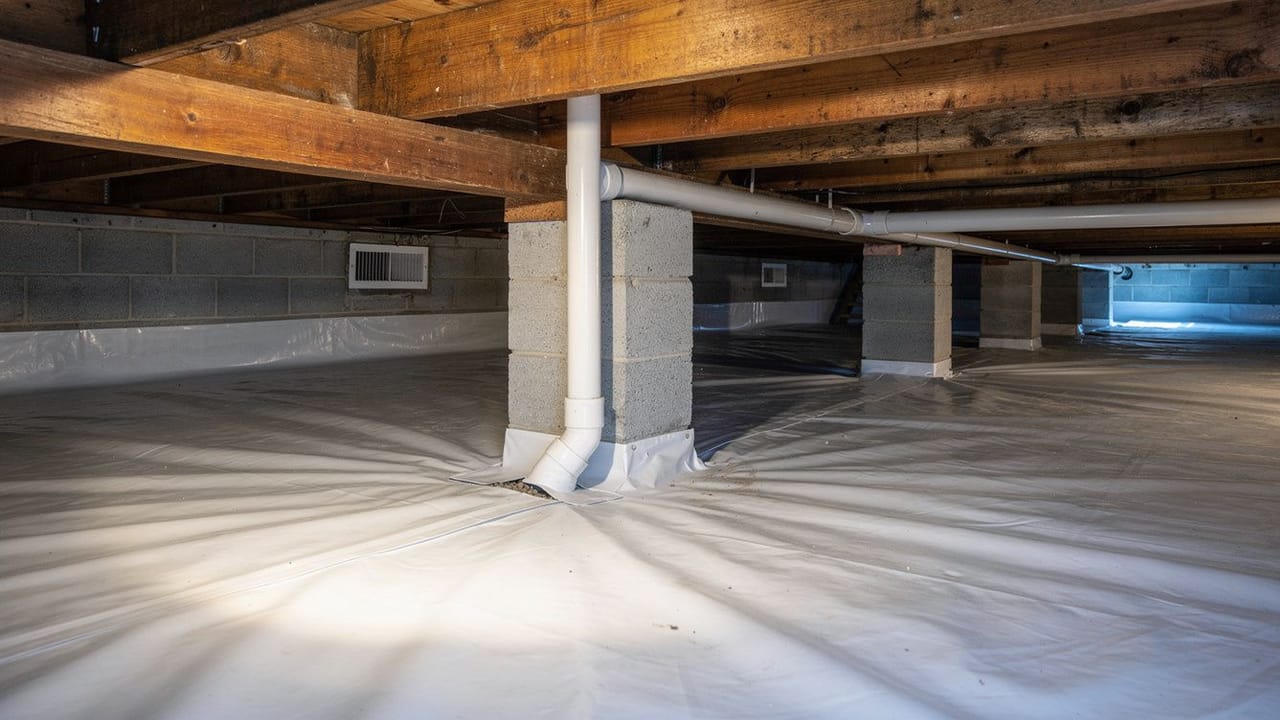
A sealed ground cover slows soil gas, but plastic by itself is not a radon system. The Department of Energy’s Building America Solution Center, in its guide to a capillary break at crawlspace floors, says the ground cover will also help keep soil gases from entering the home. The same guide suggests considering a passive radon venting system, which collects the gas under the plastic and carries it out through the roof in a vent pipe.
That is the link between the work we do and a radon vent. The liner we put down when we encapsulate a crawl space is the same layer a vent pipe draws from, as long as it is continuous, its seams are lapped and taped, and it is sealed at the walls and piers. Plastic that is loose, torn or stops short of the walls lets gas around it, which is why torn ground cover is one of the first things we fix. The moisture side of that floor, and why it matters in a Nashville summer, is covered on our moisture and dehumidification page.
How a vent under the plastic works
The active version is called sub-membrane depressurization. EPA’s 1993-era technical guidance, Radon Reduction Techniques for Existing Detached Houses, describes it this way: a fan pulls suction on the space under a plastic membrane over the crawl floor, and as long as enough suction is held there, soil gas entry is reduced. Any air leaking through a seam or puncture should be crawl space air drawn down into the membrane, rather than soil gas coming up.
For a house in Nashville and the rest of Davidson County, what this means in practice is that the floor we seal for moisture can be built to take a vent pipe from the start, with a spot left where the pipe comes up through the liner and a route planned to the outside. Test the house first. If the number comes back at or above the action level, the sealed floor is ready for the vent and fan, and if the crawl already needs work, tell us on our contact page what the test showed so the plan accounts for it.
That older guidance makes a few points that still shape how a crawl floor should be built for it:
- The membrane it describes is polyethylene, usually 6 to 10 mils thick, laid over the crawl floor.
- A tougher sheet such as EPDM can go down along the paths people crawl, to protect the plastic.
- A crawl space that is poorly separated from the living area is harder to depressurize well.
- Running costs include the fan’s electricity, some heating and cooling penalty, and an occasional membrane repair.
Sources
- Metro Nashville Public Health Department, Radon Information — Davidson County test results (about 40 percent of 4,152 homes elevated), entry paths, winter risk, 4 pCi/L action level
- U.S. EPA, Tennessee – EPA Map of Radon Zones — All homes should be tested regardless of zone; fix at 4 pCi/L or higher, consider between 2 and 4; the map is not for individual homes
- U.S. DOE Building America Solution Center, Capillary Break at Crawlspace Floors — Ground cover helps keep soil gases out; passive radon vent collects gas under the plastic
- U.S. EPA, Radon Reduction Techniques for Existing Detached Houses (1993-era technical guidance) — How sub-membrane depressurization works, membrane thickness, EPDM walkways, operating costs
FAQ
Radon in a Nashville Crawl Space: Test, Then Seal — questions
Is radon a problem in Nashville crawl spaces?
It can be. Metro Health reports that about 40 percent of the 4,152 Davidson County homes tested showed elevated radon. A crawl space sits on bare soil unless it is sealed, and gas can rise through gaps in the floor and around pipes, so a test is the only way to know.
What radon level is too high in a home?
EPA’s guidance is to fix a home when the radon level is 4 picocuries per liter or higher, and to consider fixing it when the level falls between 2 and 4. Metro Health uses the same 4 pCi/L action level. Read your own test against those numbers, not a county map.
Does a crawl space vapor barrier stop radon?
It slows it. The Department of Energy’s building guide says a sealed ground cover helps keep soil gases out of the house, but plastic alone is not a radon system. A vent pipe that draws gas from under the liner, passive or with a fan, is what a high test result calls for.
What is a sub-membrane depressurization system?
It is a radon system for crawl spaces. A fan pulls suction under a plastic membrane sealed over the crawl floor, so soil gas is drawn out through a pipe instead of rising into the house. EPA’s older technical guidance describes the membrane as polyethylene, usually 6 to 10 mils thick.
Is radon worse in winter in Davidson County?
Metro Health says the risk of radon exposure goes up in the winter months, when doors and storm windows stay closed and ventilation in the house drops. That is when levels are more likely to reach the 4 pCi/L action level, so a test run while the house is closed up is a useful one.