· by Michael Blair, Nashville's Crawl Space Repair
Most people search for a crawl space inspection after someone else has already been under the house. The buyer’s home inspector writes a line or two about the crawl, the line uses words like “moisture noted” or “further evaluation recommended,” and now there is a deadline and a question nobody at the closing table can answer. Before deciding what that line means, it helps to know what the inspector was required to do down there, and what they were allowed to skip. Tennessee spells both out. This is how we read a report’s crawl section, and where a crawl space inspection and photo report of our own fits in.
What a Tennessee home inspector must do under the house
Home inspectors in Tennessee are licensed by the state, and the minimum they owe a client is set by the Department of Commerce and Insurance in its Standards of Practice for home inspectors, Rule 0780-05-12-.10. The rule defines an underfloor crawl space as the area inside the foundation between the ground and the underside of the lowest floor framing. That is the space we work in, and the rule gives the inspector a short list of duties there.
Under the structural section, the inspector is to enter the crawl space, probe structural components where deterioration is suspected, report the method used to inspect the crawl, and report signs of water penetration or condensation on building components. Under the insulation and ventilation section, the inspector looks at insulation and vapor retarders in unfinished spaces and at the ventilation of foundation areas. Insulation and vapor retarders that are concealed do not have to be reported.
Read that list for what it leaves out. It asks for signs of water and condensation, not a measured cause. It asks the inspector to probe wood where decay is suspected, not to take moisture readings across every joist. It does not ask for the grading outside, the dryer vent, the sump or how the floor got out of level. A home inspection covers the whole house in one visit, and the crawl section is written to flag what should be looked at more closely, which is why so many of them end with a referral.
When the report says the crawl was not entered
The same rule lets the inspector stay out of the crawl in three situations: when access is obstructed, when entering could damage the property, or when a dangerous or adverse situation is suspected. In Middle Tennessee those look like a hatch screwed shut or buried behind a water heater, a crawl so low over the dirt that crawling through would tear down ductwork, standing water, a dead animal, or wiring hanging loose in the space.
Even then the report is not allowed to go quiet. The rule requires the inspector to report the methods used to inspect the crawl, so a report that skipped entry should say what was done instead: looked in from the access opening, photographed with a camera on a pole, checked only the visible area near the door. If the crawl section is a single sentence with no method, ask for one.
- Was the crawl entered, and how far in did the inspector get?
- If not, which of the three reasons applied, and what was seen from the opening?
- Where on the floor plan are the wet or damaged areas the report mentions?
- Were any areas probed, and what did the wood feel like?
- Are there photos of each item, not just of the access door?
What the crawl findings usually mean here
“Condensation on building components” in a Nashville crawl usually shows up as beads on ductwork, a dark film on the joists or a damp sheen on the underside of the subfloor, and it is most common in summer. The Department of Energy’s write-up on unvented, conditioned crawlspaces explains why: in humid climates the outside air is often wetter than the air already in the crawl, so the vents meant to dry it bring moisture in, and that leads to structural, mold and pest problems. We go further into that summer pattern in why a crawl space is wet in summer.
How wet is too wet for the framing is a number, not a feeling. A technical note from the NAHB’s Home Innovation Research Labs and ICC Evaluation Service, Floors above Crawl Spaces, puts the upper limit for wood moisture content at about 20 percent to protect against decay, and notes that wood settles near 10 percent at 50 percent relative humidity and near 13 percent at 70 percent. A meter reading on the joists and sill tells you whether the wood is sitting in that range or above it; a home inspection usually does not take one.
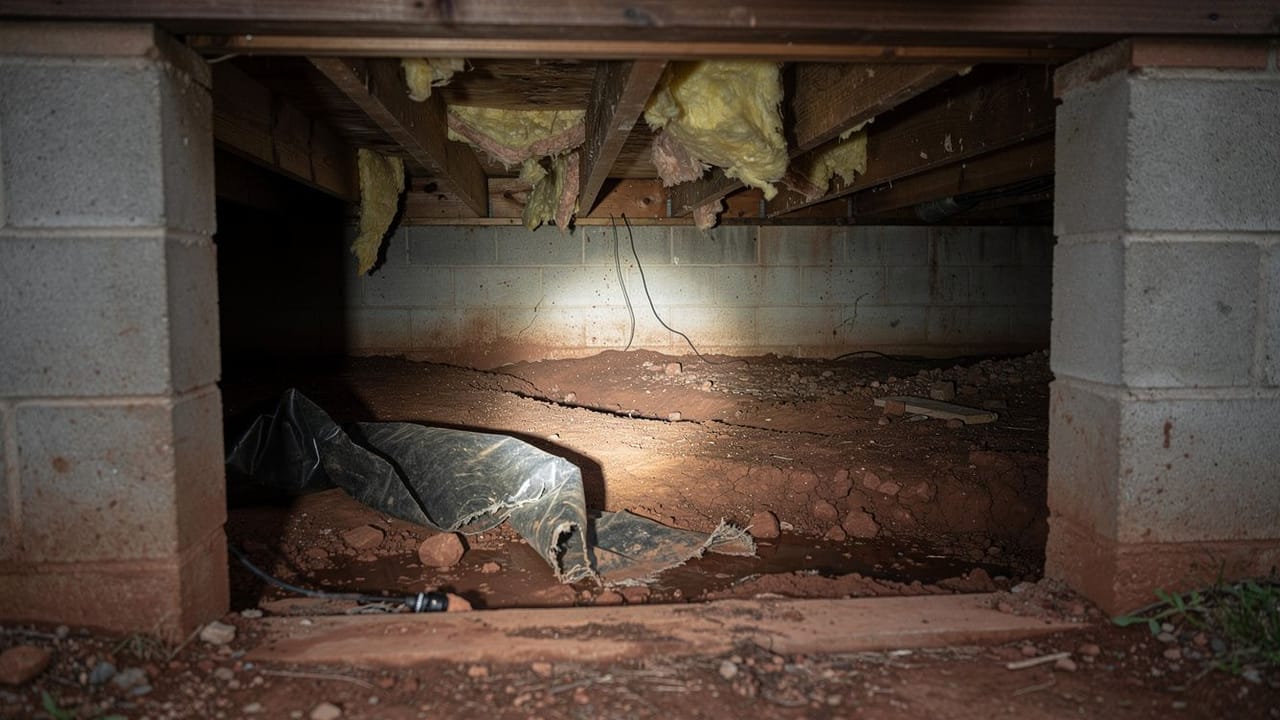
Insulation findings are easier to judge. Batts on the ground or hanging loose from the joists are visible to anyone, and “vapor retarder damaged or incomplete” means the plastic over the dirt is torn, missing in places or never covered the whole floor. A “floor slope” or “deflection” note points to the framing and the piers, which is its own subject, covered in sagging floors and what is under them.
Getting a closer look before the deadline
When the home inspector writes “recommend evaluation by a qualified contractor,” the next visit should answer what the first one could not: where the water is coming from, whether the wood is wet or just stained, which framing is soft, and what is urgent versus what can wait. Our crawl space inspection goes all the way through the space with a moisture meter and a camera, and the report shows each finding on the house with a photo and a reading, split into what needs work now and what can be watched. A buyer can hand that report to the seller as it is.
Code matters if repairs come out of it. In Davidson County, Metro Codes’ adopted codes list shows the 2024 International Residential Code with local amendments, and Metro’s announcement of the adoption set it in effect for plans and applications submitted after July 16, 2025. Closing and conditioning a crawl is a code-recognized repair, not a workaround: the Department of Energy credits field research, which measured 15 to 18 percent heating and cooling savings and crawl humidity cut by more than 20 percent, with shaping the unvented crawl provisions of R408.3 in the 2009 and 2012 IRC. A repair proposal for a house in Nashville and the rest of Davidson County should name what it is built to.
If you are under contract and the report flagged the crawl, ask for an inspection on our contact page and tell us the date your inspection period ends. We would rather know the deadline up front than learn it from the photos.
Sources
- Tenn. Comp. R. & Regs. 0780-05-12-.10, Standards of Practice for Home Inspectors (Tennessee Department of Commerce and Insurance, via Cornell LII) — Definition of an underfloor crawl space; entry, probing, reporting the inspection method and signs of water or condensation; the three exceptions to entry; insulation, vapor retarders and foundation ventilation.
- NAHB Home Innovation Research Labs and ICC-ES, TechNote: Floors above Crawl Spaces (2014) — About 20 percent wood moisture content as the upper limit against decay; wood near 10 percent at 50 percent RH and 13 percent at 70 percent RH.
- U.S. Department of Energy, Unvented, Conditioned Crawlspaces: Building America Top Innovation — Outside air in humid climates often wetter than crawl air, leading to structural, mold and pest problems; 15 to 18 percent heating and cooling savings and humidity cut by over 20 percent; research that shaped IRC R408.3 in 2009 and 2012.
- Metro Nashville Codes, Adopted Codes List — 2024 International Residential Code with local amendments in Davidson County.
- Metro Nashville Codes, Metro Adopts 2024 International Building Codes — Effective for plans and applications submitted after July 16, 2025.