
· by Michael Blair, Nashville's Crawl Space Repair
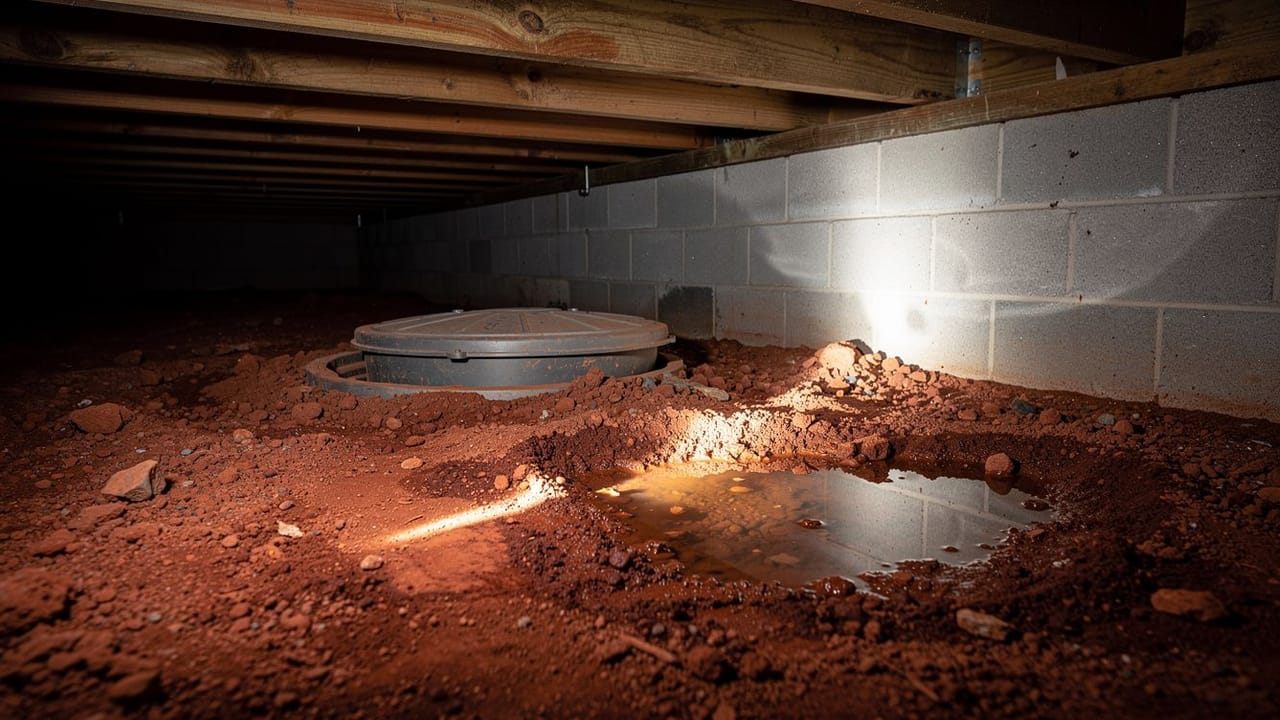
Water standing on the dirt under a house is not a humidity problem. Humid air makes a crawl space damp; a puddle means liquid water is getting in from somewhere, and it will keep getting in until that path is dealt with. In Middle Tennessee the ground under most houses is clay, which sheds water slowly and holds it against the foundation after a hard rain, so a crawl that stays dry in a dry month can flood every spring. Waterproofing is the word people search for, but it covers several different repairs, and which one a house needs depends on where the water starts. Our crawl space drainage and sump work begins with that question.
Four ways water ends up under the house
The most common source is the yard itself. Soil that settles against the foundation over the years ends up sloping toward the house instead of away from it, and every rain runs straight to the block wall. The 2018 Tennessee Residential Code, R401.3 says the grade shall fall not fewer than 6 inches within the first 10 feet from the foundation. Plenty of older lots no longer do, and a flowerbed edged with timbers or a patio poured toward the house can undo it on a newer one.
Downspouts come next. A gutter collects the water from a whole section of roof and the downspout drops all of it in one spot, often right at the corner of the foundation. The PNNL Building America Solution Center’s gutter guidance calls for downspouts to end at least 5 feet from the foundation, or in an underground catchment at least 10 feet away, and the Department of Energy’s guide to closing ventilated crawlspaces sets a minimum of 10 feet for drains and bubblers.
The other two are harder to see from outside. On clay, rainwater that soaks in can sit on the dense layer below and move sideways until it finds the gap between the footing and the soil, then seep up through the crawl floor, which is why some crawls are wettest a day or two after the rain stops. And sometimes the water is the house’s own: a supply line weeping at a fitting, a tub drain that leaks only when the tub drains, a cracked cleanout. A plumbing leak leaves a wet patch under one bathroom or the kitchen rather than a band along the wall, and the dirt below it stays wet in a dry week.
What waterproofing a crawl space actually involves
A crawl space is not waterproofed the way a basement wall is, with a coating that keeps water from passing through. It is managed. Building Science Corporation’s Information Sheet 512 puts it plainly: crawlspaces should be built as mini-basements, with a continuous sealed ground cover, and where the crawl floor sits below the surrounding grade it should have perimeter drainage just like a basement. The same sheet recommends sloping the ground to a drain so a plumbing leak has somewhere to go.
In practice that is three pieces. First, an interior drain: a trench along the inside of the foundation wall with perforated pipe in gravel, running to a sump basin with a pump that sends the water out and away from the house. Second, a vapor retarder on the ground, sealed at its seams and run up the walls, so moisture rising out of the soil stays under the plastic instead of in the air around the framing. Third, closing the crawl, so outside summer air stops bringing its water in through the vents.
The details matter more than the parts list. The Department of Energy closing guide calls for a lid on the sump pit with its penetrations sealed and a check valve in the pump’s discharge line, so the basin does not become a source of damp air and the water the pump lifts does not run back down. Where the discharge ends outside counts too; a pump that empties beside the foundation sends the same water back around.
- Interior perimeter drain in gravel, sloped to the sump
- Sump basin with a sealed lid and a check valve on the discharge
- Discharge carried well away from the foundation
- Sealed vapor retarder over the ground and up the walls
- Vents and openings closed once the water is under control
What the code says about a wet crawl space
The 2018 Tennessee Residential Code is the 2018 International Residential Code with the state’s amendments, and its crawl space section is R408 in Chapter 4. The basement rules for foundation drains (R405.1) and dampproofing (R406.1) apply to walls that enclose habitable or usable space below grade, so they are written for basements; a plain crawl space falls mainly under R408 of the 2018 Tennessee Residential Code.
R408.6 is the part that speaks to standing water. Where the groundwater table can rise to within 6 inches of the finished floor, or where surface water does not drain, the code requires the grade under the floor to be as high as the outside grade unless an approved drainage system is provided. A crawl floor dug lower than the yard is exactly the kind that collects water, and the drain to a sump is the approved path most houses take.
R408.3 covers the closed, unvented crawl. It calls for a continuous Class I vapor retarder with joints overlapped 6 inches and sealed or taped, and edges carried at least 6 inches up the stem wall and sealed. The closed crawl also needs one way to keep its air dry: continuous exhaust or a conditioned air supply at 1 cfm for every 50 square feet with the perimeter walls insulated, a plenum in an existing house, or a dehumidifier rated at 70 pints a day per 1,000 square feet. Closing a crawl without one of those is not what the code describes.
What a crawl space system will not fix
A drain and a sump handle water that has already reached the crawl. They do nothing about a downspout emptying against the wall or a yard that slopes toward the house, and a pump that runs after every rain is usually the sign that the outside work was skipped. Regrading and extending downspouts come first because they keep the water out of the ground next to the house to begin with, and the EPA’s guide to mold and moisture lists making sure the ground slopes away from the foundation among its first steps. A plumbing leak gets fixed by a plumber, not drained.
The system also does not dry out wood that has been wet for years or straighten joists that have rotted at the sill. The EPA notes that wet materials dried within 24 to 48 hours in most cases will not grow mold, and a crawl that has puddled every spring has been well past that many times. Once the water stops, the framing gets looked at, and the air is held where the EPA’s guidance puts it: below 60 percent relative humidity, ideally between 30 and 50.
Whether to go on and fully seal the crawl once it is dry is a separate decision, covered in whether crawl space encapsulation is worth the cost. Homes on the newer subdivisions around Spring Hill and on the older lots closer in see the same water problems for different reasons, so we look at the yard, the gutters and the crawl on the same visit. If there is water under your house, ask for a free estimate and we will trace where it starts before we suggest anything for the crawl.
Sources
- 2018 Tennessee Residential Code (IRC 2018 with Tennessee amendments), Chapter 4, R401.3, R405.1, R406.1, R408.3 and R408.6 — Grade falling 6 inches in 10 feet, basement-only drain and dampproofing rules, unvented crawl space vapor retarder and drying options, and the drainage requirement for a crawl below grade.
- EPA, A Brief Guide to Mold, Moisture and Your Home — Humidity below 60 percent, ideally 30 to 50; drying within 24 to 48 hours; ground sloping away from the foundation.
- Building Science Corporation, Information Sheet 512: Crawlspace Insulation for All Climates — Crawlspaces built as mini-basements, a continuous sealed ground cover, perimeter drainage where the floor is below grade, and sloping to a drain for plumbing leaks.
- U.S. Department of Energy Building America (IBACOS), Guide to Closing and Conditioning Ventilated Crawlspaces — Downspout discharge at least 10 feet from the foundation; sump pit lids, sealed penetrations and a check valve on the discharge.
- PNNL Building America Solution Center, Gutters and Downspouts — Downspouts ending at least 5 feet from the foundation, or in an underground catchment at least 10 feet away.