
· by Michael Blair, Nashville's Crawl Space Repair
A dehumidifier under the house is easy to forget until the floors feel damp again or the musty smell comes back. Then someone opens the crawl space hatch and finds the unit humming, or silent, with nothing coming out of its drain line. Most of the time the cause is ordinary and fixable: the filter, the drain, the setting, or the air it is working in. Here is how we sort out which, using what the makers of these units say in their own manuals, and where the line falls between a homeowner check and a service call.
Why would a crawl space dehumidifier run without pulling water?
A crawl space dehumidifier that runs without pulling water is most often short of air because of a dirty filter, working in air that is already near its set point, or running a coil that has frosted over. Air has to cross the cold coil for water to condense on it, and anything that slows the air cuts what the unit collects.
The Santa Fe Advance2 installer’s and owner’s manual is plain about the filter. It calls for checking the MERV 8 pleated filter every six months, says it can usually be vacuumed clean a few times before it needs replacing, and warns that a dirty one lowers capacity and efficiency and can make the compressor switch on and off needlessly. It also says never to run the unit without a filter, because the coils inside can clog badly enough to need taking apart. AprilAire’s owner FAQ names the same two jobs as the required maintenance on its E-Series units: clean the filter and clean the drain.
Under a house the filter loads faster than people expect. Dust off the ground, insulation fibers and whatever drifts in through the vents of an older crawl space all end up on it.
Is the dehumidifier broken, or is the crawl space already dry?
Sometimes a dehumidifier collects nothing because there is little to collect: the crawl space is already at or below its setting, or the air is cool enough to hold less water. AprilAire’s FAQ explains that its units with an onboard control switch the blower on for 3 minutes in every hour to read the air, and start the compressor only when humidity is above the set point. A unit that sits quiet for most of the hour may be doing exactly what it should.
The Santa Fe manual describes its control from the other side: it switches on when humidity reaches the dial setting and off once humidity falls 4 to 6 points below it. AprilAire adds that its units are designed for air between 65 and 80 degrees F, and that cooler air holds less moisture, so they remove less. That is why a unit that kept its drain line running in August can go nearly dry in November.
The way to know is a humidity reading in the crawl space from a separate meter you trust, not the unit’s own dial. The EPA’s brief guide to mold and moisture recommends holding indoor humidity under 60 percent, and ideally in the 30 to 50 percent range. If the meter under the house reads in that range, the dehumidifier is not the problem. If it reads well above it and the unit is idle, something is wrong. What cold does to the coil is covered in sizing a crawl space dehumidifier.
Why does a crawl space dehumidifier leak or shut itself off?
A crawl space dehumidifier usually leaks or shuts itself off because its water cannot get away: a hose that kinked, sagged uphill or clogged, a trap set wrong, or a condensate pump that failed. The EPA guide asks for the same attention on any cooling equipment, keeping drip pans clean and drain lines open and flowing.
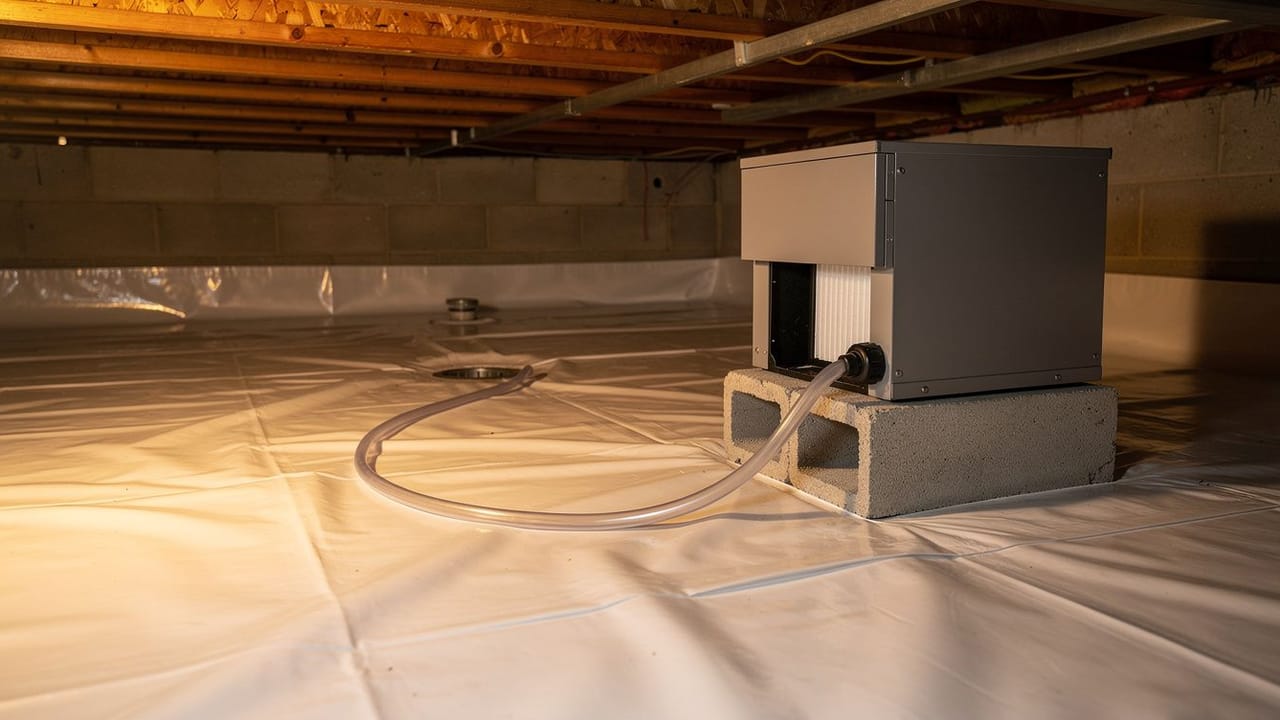
The Santa Fe manual shows how little it takes. That unit drains by gravity only, so the hose has to run downhill all the way to the drain, and it needs a trap in the hose to keep air from flowing back in. The trap belongs about 8 to 10 inches from the unit with its highest point at least 2 inches below the drain port; set it higher and water backs up into the machine and out of its corners. The manual says to check the hose regularly.
Where a unit sits lower than any drain, a condensate pump does the lifting, and many of those pumps carry a switch that turns the dehumidifier off if the pump fails. That looks like a dead dehumidifier and is not. How a drain line should be run in the first place is in setting up a crawl space dehumidifier.
What a homeowner can check, and what needs a technician
A homeowner can safely check power, the setting, the filter and the drain; anything inside the cabinet belongs to a qualified technician. The Santa Fe manual’s homeowner list covers power, the humidity control and airflow through the filter and grille, and we add the drain. Unplug the unit before touching the filter.
In practice that means checking the plug, the outlet and the breaker, including a GFCI outlet that may have tripped; making sure the humidity control is set to a working number, not off; vacuuming or washing the filter as the manual for that unit says; walking the drain hose to confirm it runs downhill with no kinks, its trap below the drain port and any pump running when its reservoir fills; and taking a humidity reading in the crawl space from a separate meter.
Past those checks the fault is inside a sealed refrigeration system. The Santa Fe manual traces a coil that stays frosted with low output to a dirty filter or blocked airflow first, then to a loose or failed defrost thermostat or a low refrigerant charge, and it warns that the high-pressure refrigerant and high-voltage wiring make service a job for qualified people only.
When a unit needs that kind of attention, or replacing, it falls under our crawl space moisture and dehumidification work, in Mount Juliet and across the rest of Middle Tennessee. If the floors feel damp again and the unit under the house is not keeping up, send us a note.
Sources
- Santa Fe Advance2 Installer’s and Owner’s Manual (part 4034180) — MERV 8 filter checked every six months; dirty filter cuts capacity and causes needless compressor cycling; gravity drain, trap 2 inches below the port; humidity control cuts out 4 to 6 points below set point; homeowner checklist; frosted coil causes; qualified service only.
- AprilAire, Owner Center Frequently Asked Questions — E-Series maintenance is cleaning the filter and the drain; onboard control samples the air 3 minutes each hour; designed for 65 to 80 degrees F, removing less moisture in cooler air.
- U.S. EPA, A Brief Guide to Mold, Moisture and Your Home — Keep drip pans clean and drain lines flowing; indoor humidity below 60 percent, ideally 30 to 50 percent.
FAQ
Crawl Space Dehumidifier Not Removing Water — questions
Why is my dehumidifier not removing water?
Usually a dirty filter, air already at the set point, air too cool to hold much moisture, or a frosted coil. Check the filter, the setting and a humidity reading from a separate meter first. A coil that stays frosted behind a clean filter points to the defrost control or the refrigerant charge, which is work for a technician.
How often should a crawl space dehumidifier filter be cleaned?
Follow the manual for your unit. Santa Fe’s Advance2 manual says to check its MERV 8 filter every six months and vacuum it clean, replacing it after a few cleanings. AprilAire lists filter cleaning as required maintenance on its E-Series units. A dusty, vented crawl space can load a filter sooner than that.
Why does my crawl space dehumidifier keep turning on and off?
Some cycling is normal: AprilAire units run the blower 3 minutes an hour to sample the air before starting the compressor. A compressor that switches on and off rapidly is different. The Santa Fe manual ties that to a dirty filter, or, when the blower is not running at all, to a fault in the blower or its circuit.
Can a crawl space dehumidifier be repaired?
Often, yes. Filters, drain hoses, traps and condensate pumps are simple to clean or replace. Faults inside the cabinet, such as the blower, the defrost thermostat or the refrigerant charge, can be repaired too, but Santa Fe’s manual sends that work to qualified service people because of the refrigerant pressure and the wiring.
Why is water leaking out of my crawl space dehumidifier?
Water leaking from the cabinet usually means the condensate cannot drain. On a gravity-drained unit, check that the hose runs downhill without kinks and that its trap sits below the drain port; Santa Fe’s manual says a trap set too high backs water into the unit. A failed condensate pump is the other usual cause.