
· by Michael Blair, Nashville's Crawl Space Repair
A crawl space that stays muggy all summer raises two worries: the mold people can see on the joists, and the rot they cannot. Those are separate problems, and damp air alone does not cause the second one. Decay fungi need wood far wetter than humid air can make it, and water in that amount reaches a crawl as liquid: condensation fed by the soil, a slow plumbing leak, runoff that comes in at the foundation. Here is where the line between mold and rot sits, how framing gets pushed over it, and what drying the space does about it. Getting a crawl dry and keeping it that way is the work of our moisture and dehumidification service.
Does a humid crawl space rot joists, or only grow mold?
A humid crawl space can grow mold on the joists, but humid air by itself does not wet them enough to rot. Chapter 14 of the Forest Products Laboratory’s Wood Handbook, on biodeterioration of wood, separates the two plainly. Water vapor alone, it says, will not bring wood to a moisture level that supports significant decay, though it can let some mold fungi develop. Serious decay, by the same chapter, happens only in wood wetter than its fiber saturation point, a level the handbook puts at about 30 percent on average.
So a crawl that feels like a damp basement in July is a mold problem and an early warning, not proof that the floor framing is decaying. Whether decay is under way depends on one question: is liquid water reaching the wood? That is what we go looking for next, with a light, a meter and the run of the pipes.
How does crawl space framing get wet enough to decay?
Crawl space framing gets wet enough to decay from liquid water, and the Wood Handbook names the usual routes. It warns that condensation on the joists and subfloor of a house over a crawl, rather than a basement, can lead to serious decay, and that the moisture behind that condensation comes mostly from the soil. Bare ground keeps giving off water into the crawl, and in a Middle Tennessee summer that water collects on wood and pipes cooler than the air around them. Clay soil here stays wet long after a rain, so an uncovered dirt floor keeps the supply going.
Plumbing is the second route. The handbook warns that leaks can do serious decay damage inside buildings, especially when they go unnoticed for a long time, and a crawl is exactly where a weeping drain joint can run for months unseen. The third is water from outside: runoff that comes through the foundation wall or stands on the dirt after storms. When we inspect a crawl space, we trace each patch of wet wood back to one of those sources before recommending anything.
Does mold on the joists mean the wood is rotting?
Mold on crawl space joists means the wood surface has stayed damp, not that the wood is decaying. The Wood Handbook draws that distinction: the humidity that lets some molds grow is less water than significant decay needs. EPA’s brief guide to mold, moisture and your home adds that no type of mold grows without water or moisture, so mold anywhere under the house is a sign there is moisture to find and remove.
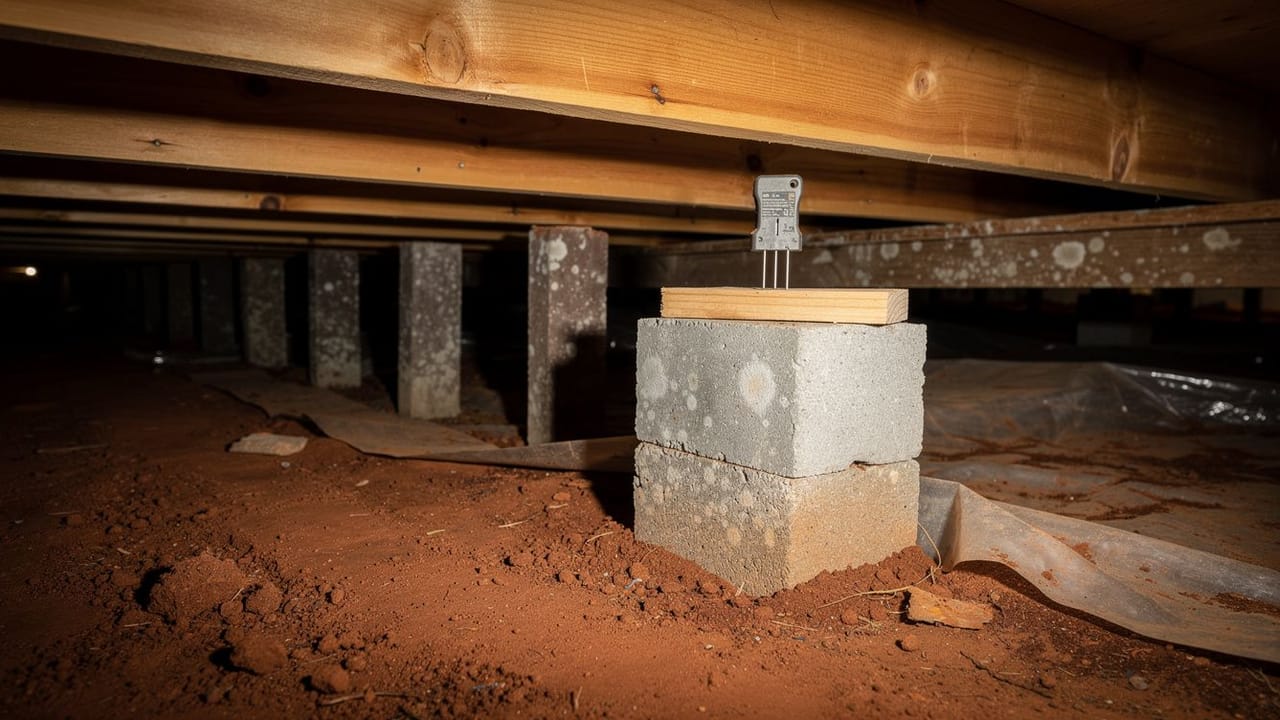
What separates a moldy joist from a decaying one is the water content of the wood, and we measure it with a moisture meter instead of judging by color. Framing that reads in the twenties is wood we want dried before anything else; framing near or above 30 percent is wet enough for decay fungi, and we look hard for the water putting it there. Wood that has already lost strength is a structural repair job, quoted on its own. On sound framing the order is the water first and the mold after it.
Drying the crawl and keeping the framing air dry
Keeping crawl space framing air dry is what stops decay, and the Wood Handbook gives the figure. Wood that has dried in open air typically sits at 20 percent moisture or below, and the handbook treats that as enough of a buffer to keep fungi from doing damage. Held at that level, framing does not decay, and any decay begun during an earlier wet spell stops where it is. Drying the space is therefore worth doing even where some joists already show damage.
For the ground itself, the Wood Handbook recommends covering the dirt with a sheet such as polyethylene. The Building America Solution Center’s guide to unvented, insulated crawlspaces covers the floor and the perimeter walls with 6-mil polyethylene and says a closed crawl lowers the risk of condensation, mold and wood rot. It also says to deal with standing water, mold and rotten wood before the retrofit, not after.
We work in that order: drainage where water stands, then the liner and encapsulation, then humidity control. After a leak, EPA’s guide says to dry wet areas within 24 to 48 hours to head off mold. Why a Nashville crawl stays wet in summer explains where the damp comes from; to have the framing under your house metered, ask us for a free estimate.
Sources
- USDA Forest Service, Forest Products Laboratory, Wood Handbook (FPL-GTR-282, 2021), Chapter 14: Biodeterioration of Wood — Serious decay only above fiber saturation (average 30 percent); humid air alone permits some mold but not significant decay; air-dried wood at 20 percent or less gives a safety margin and decay does not progress; crawl space condensation from soil moisture and a polyethylene barrier on the soil; undetected plumbing leaks.
- U.S. EPA, A Brief Guide to Mold, Moisture and Your Home — No mold grows without water or moisture; dry water-damaged areas within 24 to 48 hours.
- U.S. Department of Energy, Building America Solution Center: Unvented, Insulated Crawlspaces — 6-mil polyethylene over the floor and perimeter walls; a closed crawl reduces condensation, mold and wood rot; address standing water, mold and rotten wood before the retrofit.
FAQ
Crawl Space Humidity: Mold on Joists or Rot? — questions
Can high humidity in a crawl space rot floor joists?
Not by itself. The Forest Products Laboratory’s Wood Handbook says the water vapor in humid air does not wet wood enough for significant decay, though some molds can grow. Rot needs liquid water reaching the wood: condensation fed by bare soil, a plumbing leak or runoff. Humid air is still a warning worth acting on.
Is mold on crawl space joists structural damage?
Mold alone is not. It shows the wood surface has stayed damp, and the Wood Handbook says humid air can grow mold without wetting wood enough to decay. A moisture meter tells you which side of that line the framing is on. Remove the moisture first, since EPA notes mold cannot grow without it.
Can a slow plumbing leak rot crawl space joists?
Yes, and it is one of the main ways framing gets wet enough. The Wood Handbook warns that plumbing leaks cause serious decay inside buildings, especially when they go unnoticed for a long time. A weeping drain joint under a bathroom can soak the wood beneath it for months, so check the pipe runs whenever you go under the house.
Will a dehumidifier keep crawl space joists from rotting?
It helps keep the framing air dry, around 20 percent moisture or less, where the Wood Handbook says decay does not take hold. It does not stop liquid water. A leak, standing water or bare wet soil has to be dealt with first, then the ground covered and the space sealed, with the dehumidifier holding it dry.