
· by Michael Blair, Nashville's Crawl Space Repair
Most people shopping for a crawl space dehumidifier start with the number on the box, pints per day, and the square footage of the crawl. Neither one sizes the unit by itself. The rating is measured under fixed test conditions that changed in 2019, the best-known sizing chart is written for rooms in a house, and a crawl that runs cool can keep a unit from drying at all. This is how we size the units our crawl space moisture service puts under a house, and what to read on a spec sheet before buying one.
What does the pints-per-day rating actually measure?
It measures how much water the unit pulls out of the air in 24 hours under the test conditions, not under your house. ENERGY STAR’s page on dehumidifier testing and capacity defines capacity as water removed per day at test conditions, and explains that the Department of Energy procedure that took effect in June 2019 tests portable units at 65 degrees F rather than 80. Cooler air holds less water, so the same machine reports a smaller number under the newer test.
The drop is not small. The same ENERGY STAR page gives a rough conversion: a portable rated 50 pints a day under the old test lands near 30 under the new one, and a 70-pint unit near 40 to 45, while a whole-home unit rated 100 pints falls to about 85. It adds that the change varies from model to model and that the manufacturer can give a closer comparison. Two things follow. An older unit’s label and a new unit’s label cannot be lined up directly, and a sizing figure written before 2020 was written against the old, larger ratings.
How is a crawl space dehumidifier sized?
It is sized to the crawl’s moisture load: how much space there is and how damp that space stays with no dehumidifier running. Those are the two factors ENERGY STAR’s dehumidifier buying guide names, and it publishes a chart built on them. That chart is for portable units in rooms, split at 2,000 square feet, so we do not treat its pint ranges as a crawl space rule. What carries over is the way it grades condition: slightly to moderately damp at 50 to 75 percent relative humidity, very damp at 75 to 90 percent with damp spots on walls and floors, and wet at 90 to 100 percent, where surfaces sweat or water seeps in. A crawl with sweating walls or seepage is in that last class before anything else is said about it.
The Building America Solution Center’s guide to whole-house dehumidification notes that the Association of Home Appliance Manufacturers gives guidance by square footage and dampness, and that manufacturers’ own recommendations differ from one maker to the next. We have not found a primary source with a pints-per-square-foot figure for crawl spaces, and we do not use one. We measure the crawl, note how damp it is, and read the maker’s sizing for the specific unit against that.
The same guide makes a point that matters more under a house than inside it: supplemental dehumidification is not meant to make up for excessive air leakage. Open vents, gaps at the rim and water standing on the ground hand a dehumidifier a load it may never catch up with, so we close those off first, usually as part of crawl space encapsulation, and size the unit for the sealed crawl rather than the leaky one.
Why does coil frost matter in a cold crawl space?
Because a frosted coil stops pulling water while the unit keeps running. ENERGY STAR’s buying guide says frost can form on the coils when the air drops below 65 degrees F, and that the compressor may then cycle on and off over and over without removing moisture. Its advice is to switch a frosted unit off and let it defrost, and, where a space usually runs below 65 degrees, to consider a product specified for lower temperatures. Some units carry an anti-frost sensor that shuts them off when the air gets too cold.
Sixty-five degrees is also the temperature the current capacity test is run at, so the rating describes a unit right where frost starts to be a concern and says little about what it removes in colder air. A crawl sits below the heated rooms and against the ground, and for part of the year it can run cooler than the house above it. When we choose a unit, we read the low end of its rated operating range and how it defrosts, not only the pints printed on the front.
Larger, smaller, and what runs under the house
Between two sizes, go up. ENERGY STAR’s guide says it is better to oversize than undersize. An undersized unit runs all day and never brings the crawl down to its setting, while one with headroom gets there and cycles off, because the built-in humidistat on an ENERGY STAR unit switches it on and off to hold the level you set. The setting, where to read the humidity and how to drain the water are in our post on running a crawl space dehumidifier.
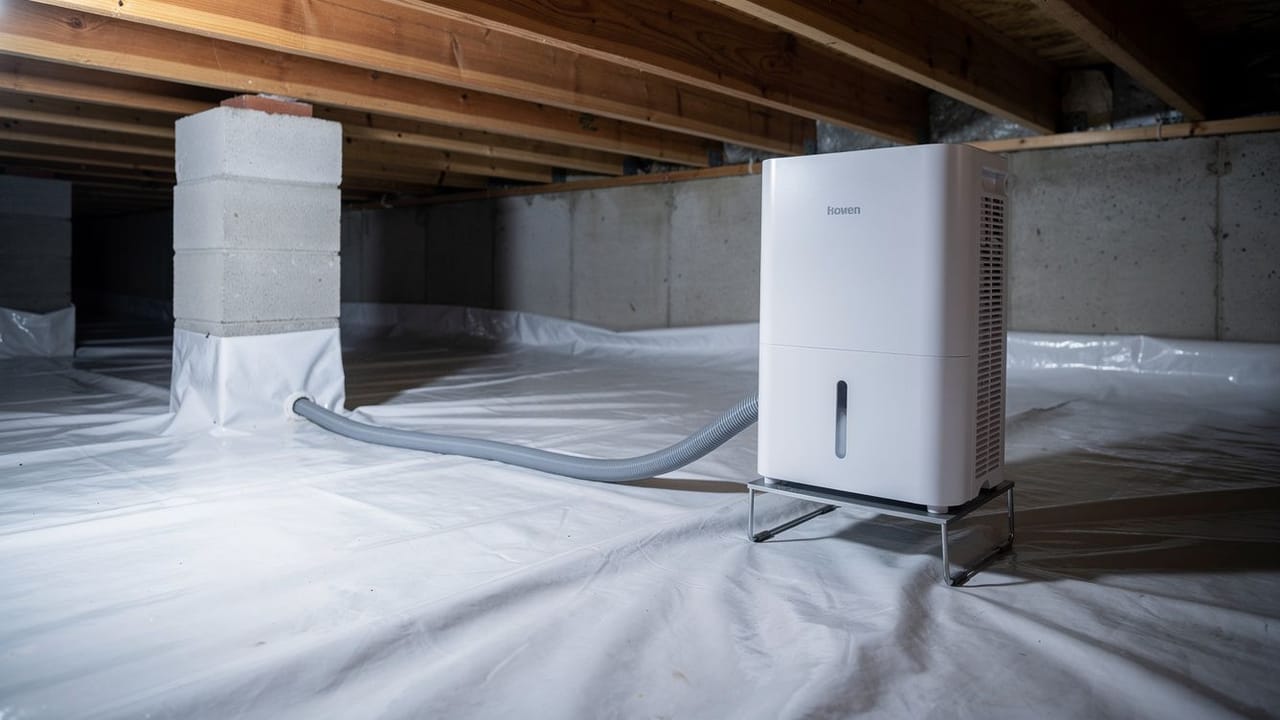
A ducted whole-house dehumidifier that dries the living space is a different job. ENERGY STAR says whole-home units should be sized and installed by a professional, and the Building America guide ties that sizing to the house’s heating and cooling design, which is work for a heating and cooling contractor. The unit we put in a sealed crawl dries the crawl. We set these units under houses in Murfreesboro and Rutherford County, Nashville and the towns between; if yours runs nonstop or the crawl still smells damp, ask us for a free written estimate and we will measure the space and tell you in writing what size it needs.
Sources
- ENERGY STAR, Dehumidifiers (buying guidance) — Capacity depends on the size and condition of the space; the room-unit sizing chart and its dampness classes; better to oversize than undersize; frost on coils below 65 F and low-temperature models; humidistat cycling; whole-home units sized and installed by a professional.
- ENERGY STAR, Dehumidifier Testing and Capacity — Capacity is water removed per day at test conditions; the June 2019 DOE test runs portable units at 65 F instead of 80 F; the rough old-to-new capacity conversion.
- U.S. Department of Energy, Building America Solution Center: Whole-House Dehumidification — AHAM guidance by square footage and dampness; manufacturer recommendations vary; supplemental dehumidification is not meant to compensate for excessive building leakage.
FAQ
Sizing a Dehumidifier for a Sealed Crawl Space — questions
What size dehumidifier do I need for a crawl space?
One sized to the crawl’s area and how damp it is with nothing running, read against the maker’s sizing for that unit. ENERGY STAR’s pint chart is written for rooms, not crawl spaces, and we know of no primary source with a per-square-foot figure for crawls. Seal the vents and stop the water first, then size for the sealed space.
How many pints per day does a crawl space dehumidifier need?
There is no single number. Ratings depend on the test, and since June 2019 portable units are rated at 65 degrees F instead of 80, which makes the same unit read lower. Compare units rated under the same test, size to the crawl’s dampness and area, and when torn between two sizes, ENERGY STAR says go larger.
Why does a dehumidifier collect less water than its rating?
The rating is water removed in 24 hours at fixed test conditions. Cooler or drier air than the test holds less water to take out, and below about 65 degrees F frost can form on the coils, so the unit cycles without removing moisture. A unit that reaches its humidity setting switches off, so it is not running flat out.
Do dehumidifiers work in cold crawl spaces?
Some do, if they are made for it. ENERGY STAR says frost can form on the coils below 65 degrees F and suggests a product specified for lower temperatures where a space usually runs that cool. Check the low end of a unit’s rated operating range and how it defrosts before buying one for a crawl space.
Is it better to oversize a crawl space dehumidifier?
Between two sizes, yes. ENERGY STAR says it is better to oversize than undersize. A unit that is too small runs constantly without reaching its setting, while one with headroom reaches it and cycles off on its humidistat. A bigger unit does not replace sealing the vents and stopping water, which keeps the load down in the first place.
Can a regular dehumidifier run in a crawl space?
A household portable is built to dry a room. Its bucket shutoff stops it when the bucket fills, and ENERGY STAR warns that coils can frost below 65 degrees F, a temperature a crawl can reach. We choose units that drain through a line and whose spec sheet covers the temperatures the crawl actually sees.