
· by Michael Blair, Nashville's Crawl Space Repair
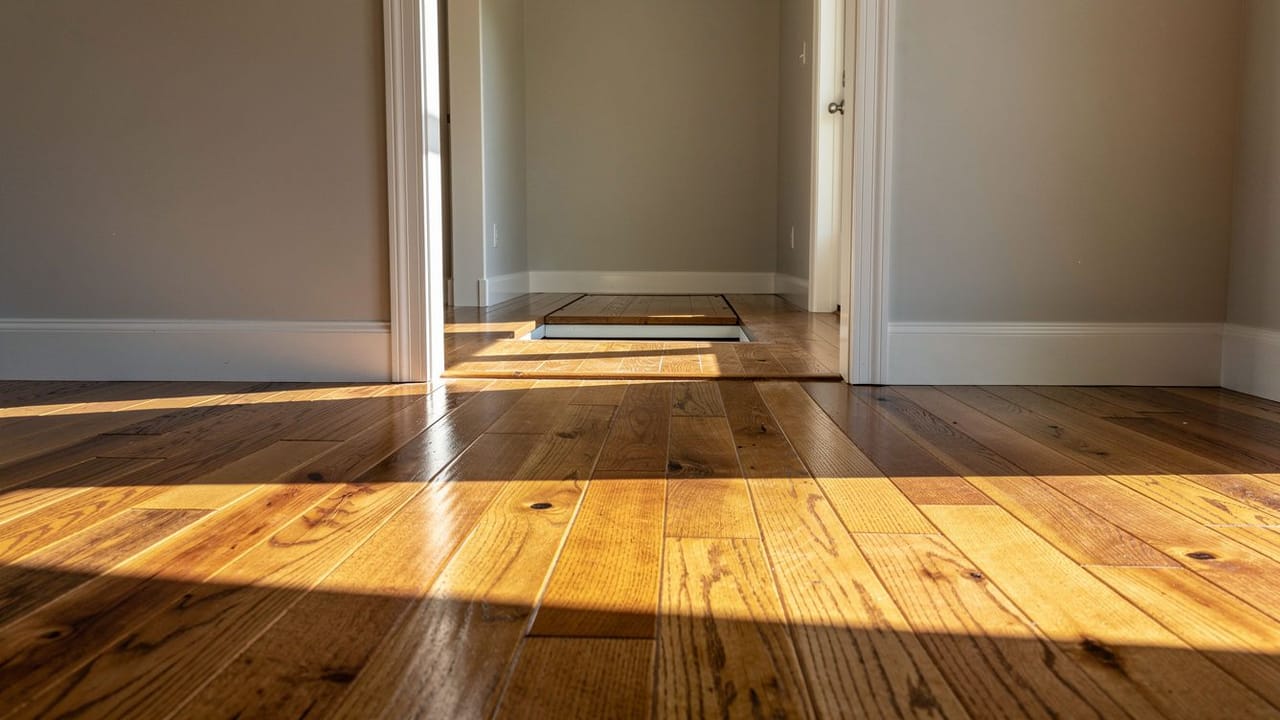
In summer some hardwood floors over a crawl space stop lying flat. The edges of each board rise above the middle, the floor feels like a washboard under bare feet, and in low light by a window you can see every seam. That shape is called cupping, and it is the wood reporting moisture. Over a crawl space, the moisture is usually coming from below. This is why it happens, what to fix first, and why the floor itself is the last thing to touch, not the first. The work under the house is what our moisture and dehumidification service does.
What makes hardwood boards cup?
Boards cup when their undersides take on more moisture than their tops, so the bottom of each board swells wider than the face and pushes the edges up. Wood grows and shrinks as its moisture content changes, and the ICC TechNote on floors above crawl spaces gives the general relationship: wood settles at about 10 percent moisture content in air at 50 percent relative humidity, and about 13 percent at 70 percent. A floor with dry, conditioned air on top and damp air underneath ends up wetter on the bottom than the top, and the difference shows as cupping.
Flooring is meant to go in already dried close to the moisture it will live at. The Wood Handbook’s chapter on drying and moisture control explains that flooring is dried to the moisture content expected in service so shrinking and swelling stay small and buckling or wide gaps do not occur, and it recommends an average of about 8 percent for interior flooring in most of the country. Outdoor air holds wood well above that. The handbook’s outdoor table for Memphis gives monthly values from 12.2 to 13.4 percent; Memphis is not Nashville, but the figures show the size of the gap between outside air and the moisture flooring is dried to.
Can a damp crawl space really cup the floor above it?
Yes, and it is the first place we look when a floor over a crawl space cups in summer. The crawl is the air directly under the subfloor. If the ground is bare or only partly covered, if vents let in humid outside air, or if water stands after rain, the subfloor and the bottoms of the boards sit in that moisture all season. Vented crawl spaces are common under older homes here, and why crawl space humidity runs high in Nashville explains what a vented crawl does in summer.
The National Wood Flooring Association’s installation guidelines (the 2007 revision) set the conditions for putting a wood floor over a crawl space at all. The crawl must be dry, with at least 18 inches from the ground to the underside of the joists, and the earth covered 100 percent by a vapor retarder of black polyethylene at least 6 mil thick or a puncture-resistant membrane meeting ASTM D-1745. Where local code requires venting, the guidelines call for perimeter vents totaling at least 1.5 square feet per 100 square feet of crawl space, unless local code says otherwise. Without vents, they call for liner seams overlapped and sealed, the liner run up and sealed to the wall, and continuous mechanical exhaust with insulated perimeter walls or a conditioned air supply.
A floor can trap moisture from the top as well. The ICC note says a vapor-impermeable covering laid over a wood floor can hold moisture in the subfloor beneath it. That covering does not create the moisture, but it keeps it from leaving, which is one more reason to fix the source below rather than the surface above.
What do you fix first when the floor has cupped?
The crawl space, then the floor. We start with whatever is putting moisture into the air under the house: open ground, a torn or loose liner, standing water, vents pulling in humid summer air, or a dryer or bath fan that ends below the floor. Our moisture work brings the crawl to steady, dry air, and where the crawl needs a sealed liner and closed vents, that is crawl space encapsulation.
Once the air below is dry, the wood starts drying back toward the moisture it was installed at, and many cupped floors settle back a good part of the way on their own. How far, and how fast, depends on how wet the wood got and for how long. That is the reason to wait. Sanding a cupped floor flat while the boards are still swollen cuts wood off the raised edges; when the boards dry and flatten, those edges end up lower than the centers, a shape called crowning. A floor still cupped after the crawl has stayed dry for a full season is the time to bring in a flooring contractor.
Keeping the floor flat every summer after
The fix only lasts if the crawl stays dry through the humid months. A dehumidifier that is sized and set correctly, a liner that stays intact and drainage that keeps water away from the walls are what hold it there, and our post on running a crawl space dehumidifier covers the settings. We work under homes across Nashville and Davidson County and the towns around it. If your floor is cupping, ask us for a free written estimate; we will check the crawl space under that room and tell you in writing what is feeding it.
Sources
- USDA Forest Service, Forest Products Laboratory, Wood Handbook (FPL-GTR-282), Chapter 13: Drying and Control of Moisture Content and Dimensional Changes (Bergman, 2021) — Flooring is dried to the moisture content expected in service to minimize shrinking and swelling and avoid buckling or gaps; about 8% recommended for interior flooring in most of the US; Table 13-1 outdoor equilibrium moisture content for Memphis, TN, 12.2% to 13.4% by month.
- National Wood Flooring Association, Installation Guidelines, Chapter 1: Jobsite Conditions (2007 revision; copy hosted by a retailer) — Crawl spaces must be dry; at least 18 in. ground to joists; 100% ground cover of 6-mil black polyethylene or ASTM D-1745 membrane; perimeter vents of at least 1.5 sq ft per 100 sq ft where code requires venting; unvented crawls need sealed overlapped seams, liner sealed up the wall, continuous mechanical exhaust and insulated walls or conditioned air.
- International Code Council, TechNote: Floors above Crawl Spaces, Reducing the Risk of Moisture Accumulation within Wood Floor Assemblies — General definitions only (the note itself is written for hot-humid climate zones): wood near 10% moisture content at 50% RH and 13% at 70% RH; wood expands and contracts with moisture content; a vapor-impermeable floor covering can trap moisture in the wood subfloor.
FAQ
Cupped Hardwood Floors Over a Crawl Space — questions
Will cupped hardwood floors flatten?
Many settle back much flatter once the moisture under them is gone. Fix the source first, usually the crawl space, and give the wood time to dry back toward the moisture it was installed at. How far it recovers depends on how wet it got. Sanding while the boards are still cupped can leave them crowned later.
Should I sand cupped floors?
Not while they are still cupped. Sanding swollen boards flat removes wood from the raised edges, and when the boards dry those edges sink below the centers, which is called crowning. Dry the crawl space first and let the floor settle for a season; then a flooring contractor can judge whether any sanding is still needed.
Can you install hardwood floor over a crawl space?
Yes, if the crawl space is dry. The National Wood Flooring Association’s 2007 guidelines call for at least 18 inches from the ground to the joists and the ground fully covered by black polyethylene at least 6 mil thick or an ASTM D-1745 membrane, with venting or sealed construction as local code requires.
Does encapsulating a crawl space fix cupping floors?
It removes the most common cause from below. A sealed liner over the ground and walls, closed vents and dehumidified air keep ground moisture and humid summer air away from the subfloor. The floor itself still has to dry back and settle afterward, and boards that stayed wet for a long time may need flooring work later.