· by Michael Blair, Nashville's Crawl Space Repair
Open the crawl space vents in summer and close them in winter is the traditional advice, and plenty of Nashville homeowners still follow it. The winter half holds up: the Department of Energy’s 2000 fact sheet on crawlspace insulation says ventilation in winter is undesirable because the aim is to keep the crawl space warmer. The summer half rests on a model of how ventilation works that does not hold in a humid climate, and it is a common reason a crawl space is wet by August. When we inspect a crawl space, the vents and what is happening around them are part of the report.
What summer air does under a Nashville house
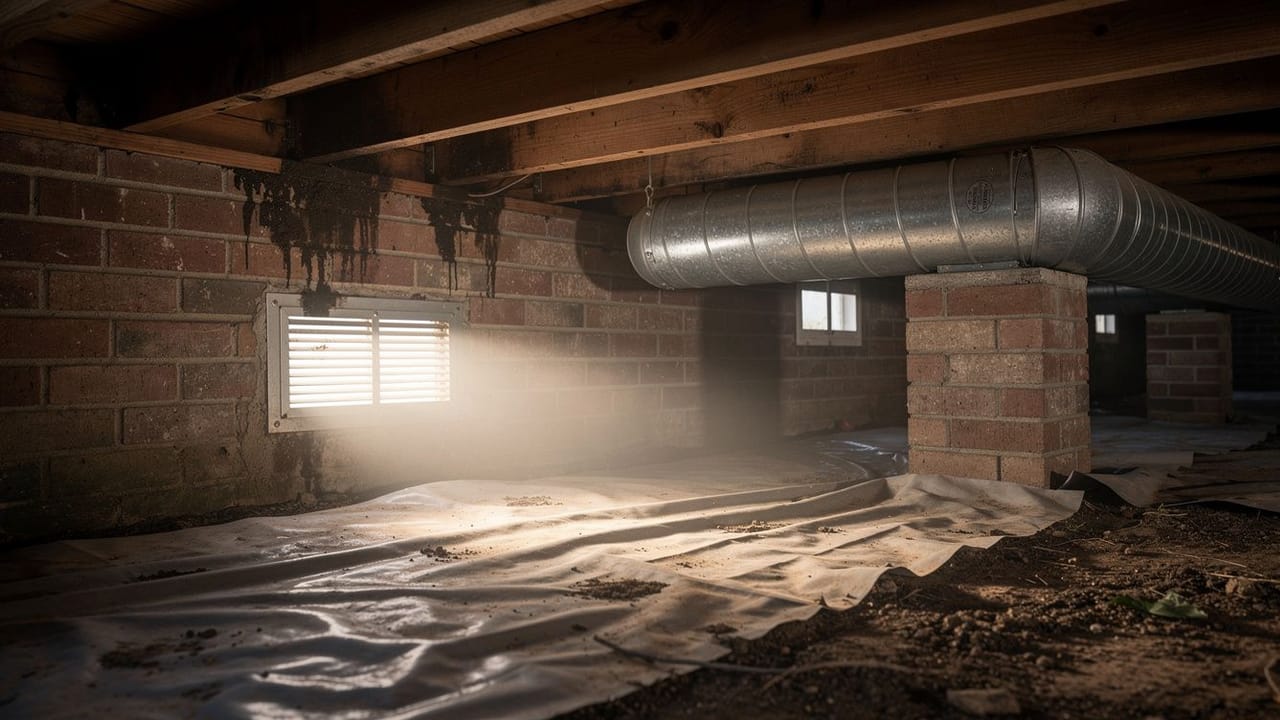
The soil under a house and the masonry around it stay cool through the summer, cooler than the air outside. EPA’s moisture control guidance for building design and construction says water may condense on foundation materials in warm weather for exactly that reason, and it works an example: air at 85°F and 60 percent relative humidity starts to condense on any surface at 70°F or below. EPA’s mold course puts the same physics in one line, that warm, humid air meeting a cold surface can form condensation.
That is how a crawl space can drip in July with no leak anywhere. The DOE fact sheet runs the numbers: crawl space air at 65°F and 90 percent relative humidity has a dew point of 62°F, while outdoor air at 90°F and 60 percent has a dew point of about 74°F, so letting that air in raises the moisture until water condenses on the floor joists, the foundation walls and the air-conditioning ducts. DOE says summer venting is often unable to dry a crawl space and can leave it wetter. On a humid August day an open vent often adds water rather than taking it away. The rest of the summer picture is in our post on why a crawl space is wet in summer.
Why do crawl spaces have vents?
Codes have required crawl space vents for a long time to help remove moisture. The DOE fact sheet says most building codes required them as of 2000, and EPA’s 2013 guidance still refers to International Building Code requirements for ventilated crawl spaces. Moving air does dry things, under one condition. EPA’s guidance says ventilating air only dehumidifies when the outdoor dew point is lower than the dew point of the air it replaces, and it puts the crawl space target below 65 percent relative humidity, reached by ventilation when outdoor dew points are under 55°F or by dehumidifiers. On a day when the outdoor dew point is higher than the crawl’s, venting works the wrong way.
Sealing is the other recognized approach. EPA’s guidance says crawl space foundations may be vented to the outdoors or air sealed, and the DOE fact sheet calls a well-sealed, unventilated crawl space, with the foundation walls insulated instead of the floor above, the better approach in homes with proper moisture control and exterior drainage. Metro Nashville now lists the 2024 International Residential Code, adopted with local amendments, under an ordinance Metro Codes says was signed July 16, 2025, and we check the current code and Metro’s amendments before we close up any crawl space.
When should crawl space vents be open?
If the crawl space stays dry, with a sound ground vapor barrier and no standing water, the least-harm routine is to keep the vents closed through the humid months and in freezing weather, and to open them only on mild spells in spring and fall when the outdoor dew point is lower than the crawl space’s. Relative humidity alone will not tell you that. Cool crawl air and warm outdoor air can read the same percentage and still hold very different amounts of water.
Very few people keep that up. A hygrometer in the crawl space settles it, and EPA’s guidance notes that a low-cost monitor reading air temperature and relative humidity is enough to work out the dew point and judge whether dehumidifying is needed. As for the number to watch, EPA’s brief guide to mold, moisture and your home says to keep indoor humidity below 60 percent, its construction guidance targets under 65 percent for crawl spaces, and its mold course names humid crawl spaces as common sites of hidden mold. If the readings stay high with the vents shut, that is the point where our moisture and dehumidification work comes in.
- Ground vapor barrier first, before any vent decision
- Close vents during humid summer and hard freezes
- A hygrometer in the crawl removes the guesswork
- Sustained readings above about 60 to 65 percent invite mold
- Standing water is a drainage problem, not a ventilation one
When sealing is the right answer
Encapsulation is the durable fix for a crawl space that will not stay dry, and it is the core of our encapsulation work. The DOE fact sheet lays out the parts: 6-mil polyethylene across the floor with the seams overlapped and taped by 12 inches and the sheet sealed 6 inches up the walls, the foundation vents eliminated or sealed, insulation on the foundation walls instead of under the floor, and the vents closed only after the crawl space and everything in it has dried out. EPA names dehumidifiers as the alternative to ventilation for holding the humidity down. DOE also lists what to check before sealing: a furnace or water heater burning fuel in the crawl should be a sealed-combustion unit, and wall insulation down there can be damaged by rodents, pests or water.
It is not a first response to a damp reading. Water coming from outside has to be stopped outside first, and DOE’s list starts there too: gutters to carry rainwater away from the house, and ground sloped away from it for at least 5 feet at a 5 percent grade. Where the lot still delivers water to the foundation, a footing drain or a sump is our drainage and sump work. Closing up a crawl space that is still taking on water skips DOE’s order of dry first, then close, and EPA’s mold course shows what that can look like, with water pooled under plastic sheeting. If you are not sure which problem you have, ask us for a free estimate.
Sources
- U.S. Department of Energy, Technology Fact Sheet: Crawlspace Insulation (2000) — Winter ventilation undesirable; summer venting often fails to dehumidify and can raise moisture (65°F/90 percent crawl air at a 62°F dew point against 90°F/60 percent outdoor air at about 74°F); most codes required vents; sealed, wall-insulated crawl space as the better approach; 6-mil poly taped and sealed up the walls; seal vents, close them once dry; sealed-combustion appliances; insulation damage by rodents, pests or water; radon system vents the crawl; gutters and a 5 percent grade; insulate water lines
- U.S. EPA, Moisture Control Guidance for Building Design, Construction and Maintenance (2013) — Condensation on cool foundation materials in warm weather; 85°F/60 percent air condenses at 70°F; ventilation only dehumidifies when the outdoor dew point is lower; crawl space target under 65 percent by ventilation below a 55°F dew point or by dehumidifiers; vented or air-sealed crawl spaces; low-cost temperature and humidity monitor
- U.S. EPA, Mold Course Chapter 2 — Warm, humid air on a cold surface can form condensation; humid crawl spaces are common sites of hidden mold; photo of water pooled under plastic sheeting in a crawl space
- U.S. EPA, A Brief Guide to Mold, Moisture and Your Home — Keep indoor relative humidity below 60 percent; condensation can be a sign of high humidity
- Metro Nashville Codes, Adopted Codes List — 2024 International Residential Code adopted with local amendments
- Metro Nashville Codes, Metro Adopts 2024 International Building Codes — Ordinance adopting the 2024 codes signed July 16, 2025
- U.S. EPA, EPA Map of Radon Zones and Supplemental Information — Test your home for radon no matter where you live (named in the radon FAQ)
FAQ
Crawl Space Vents: Open, Closed or Sealed — questions
Should I close crawl space vents in winter in Nashville?
Yes, in freezing weather. Open vents let cold outdoor air reach the water lines in the crawl, and the Department of Energy notes that winter ventilation is unwanted because the aim is to keep the crawl space warmer. Closed vents on their own are not freeze protection, though. DOE also advises insulating the hot and cold water lines in the crawl space, so we treat the pipes and the vents together.
How do I know if my crawl space is too humid?
Put a hygrometer that reads temperature as well as humidity down there and check it across a summer week. EPA advises keeping indoor humidity below 60 percent and targets under 65 percent for crawl spaces, and it names humid crawl spaces as common places for hidden mold. Condensation on ducts or pipes tells you the same thing without the instrument, since EPA treats condensation as a sign of high humidity.
Does closing the vents cause radon or moisture problems?
Closing them without the rest of the job can hold moisture in. A sealed crawl space needs a ground vapor barrier and a way to manage humidity, usually a dehumidifier, and the Department of Energy says to close the vents only after the crawl space and its materials have dried out. Radon is a separate question. EPA advises testing your home for radon no matter where you live, and DOE notes that a radon mitigation system will need to vent the crawl space to the outside.
Should crawl space vents be open in summer?
Usually not here. The outdoor air then often has a higher dew point than the crawl, so it brings in moisture that condenses on cool joists, ducts and walls, and the Department of Energy says summer venting can leave a crawl wetter. EPA counts on ventilation to dry only when outdoor dew points are below 55°F.