· by Michael Blair, Nashville's Crawl Space Repair
Encapsulation costs real money, and the companies that sell it have every reason to recommend it. We think it is the right answer for a lot of Middle Tennessee houses and more than some of them need, which is why our encapsulation work starts with a look at the crawl before anyone talks price.
What does encapsulation actually get you?
The main thing you are paying for is a drier crawl, and that reaches the rooms upstairs more than people expect. EPA’s moisture control guidance for buildings says a damp basement or crawl space may add as much water vapor to the air in a day as all the other sources inside the house combined. When the crawl is where the damp is coming from, sealing and drying it can bring indoor humidity down with it. Drier framing follows, and the same EPA document says wood will grow mold once its moisture content runs too high.
A musty smell that starts under the floor can ease once the damp is gone and the growth is cleaned off, though EPA’s guide to mold, moisture and your home is plain that mold cleaned up without fixing the water problem will most likely come back. Our post on the musty smell upstairs follows that air into the house.
We also find a dry, lined crawl a far easier place to work in, and any ductwork under the house then runs through drier air instead of the damp it sat in before. Some owners then want to keep a few sealed bins down there, and we wrote up what we would store in a dry crawl space and what we would still keep out of it.
When the full job is justified
The signs we look for on an inspection are close to the ones EPA’s moisture guidance tells inspectors to check: water stains and damp materials, mold growth, a musty odor, and wooden members that are swollen, warped or moldy. We add standing water, ground that never dries out, insulation that has dropped out of the joists, and ducts that run through the crawl.
For the wood itself, that guidance cites an upper limit of 19 percent moisture content, drawn from the California Builder’s Guide to Reducing Mold Risk and the USDA Wood Handbook. Those figures were written for lumber going into a building rather than as a test for encapsulation, but joists that read well above 19 percent tell us the crawl is wetter than framing should be. Two or three of these signs together is usually enough for us to recommend the full job.
- Standing water or damp ground: yes
- Mold growth on joists: yes
- Ducts running through the crawl: favors it
- Dry crawl, good drainage, no odor: a ground barrier may be enough
- Slab house with no crawl: not applicable
When less will do
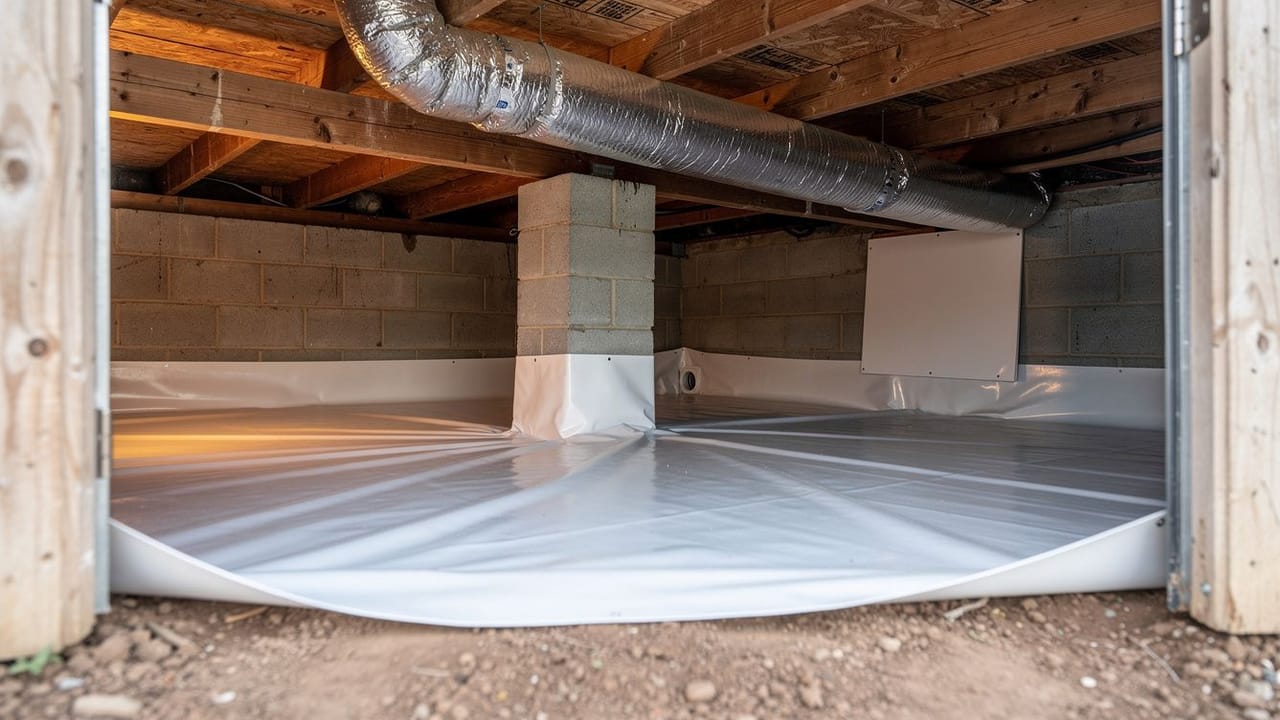
A crawl that is dry, drains well and shows no odor or growth may need only a vapor barrier over the ground. EPA’s guidance describes a plastic or elastomeric membrane over the soil as a way to keep moisture from evaporating out of the ground into the crawl space, and notes that a membrane is cheaper and easier to install than a concrete slab. A ground barrier is one piece of an encapsulation, so it costs less than the whole system.
It is worth asking for by name, since a company that sells full systems may not offer it first. Whether a dehumidifier belongs in the crawl is its own question: the same EPA guidance says to monitor relative humidity to decide, and to hold it under 65 percent, either with ventilation when outdoor dew points are below 55°F or with a dehumidifier. Our post on running a crawl space dehumidifier covers the setup when the answer is yes.
What should an encapsulation quote include?
We would want to see the barrier’s thickness, whether it runs up the foundation walls, and whether it is sealed at the seams and around piers and pipes. Look for whether the rim joist is sealed, which we handle as part of insulation and air sealing, and whether a dehumidifier is included, how it drains, and whether anyone measured the humidity before adding it to the price.
Ask what happens to mold already on the wood. EPA’s mold cleanup guidance says not to paint or caulk over moldy surfaces and to fix leaks and other water problems as soon as possible, and we would not lay a liner over growth and leave it there either.
Then check whether the quote deals with the water outside. EPA’s moisture guidance specifies a 5 percent slope away from the foundation, about 6 inches over 10 feet, carried out 6 to 10 feet from the wall, and its mold guide says the ground should slope so water does not enter or collect around the foundation. Sealing a crawl that water still gets into is containment rather than a fix, so grading, downspouts or a drain and sump come first. If the work changes how the crawl is vented, ask which code it is built to; in Davidson County that is the 2024 International Residential Code with local amendments, according to Metro Nashville Codes’ adopted codes list. We are glad to read over a quote you already have or give you our own free estimate.
Sources
- U.S. EPA, Moisture Control Guidance for Building Design, Construction and Maintenance (2013) — Damp crawl spaces as a water vapor source; wood mold risk and the 19 percent moisture limit; inspection signs; ground membrane; crawl humidity under 65 percent by ventilation or dehumidifier; 5 percent grade away from the foundation
- U.S. EPA, A Brief Guide to Mold, Moisture, and Your Home — Mold returns if the water problem is not fixed; ground should slope away from the foundation; dead mold can still cause allergic reactions
- U.S. EPA, Mold Cleanup in Your Home — Do not paint or caulk moldy surfaces; fix leaks and water problems as soon as possible
- Metro Nashville Codes, Adopted Codes List — 2024 International Residential Code adopted in Davidson County with local amendments
FAQ
Is Crawl Space Encapsulation Worth the Cost — questions
Does encapsulation lower energy bills?
It may, but we would not buy it for that. Any savings depend on the house, and we do not quote a payback figure. The reasons we recommend it are about moisture: a drier crawl, drier framing and less damp air reaching the rooms above.
Is a vapor barrier enough on its own?
In a dry, well-drained crawl with no odor or growth, a properly installed ground barrier can be adequate and costs less than the full job. In a crawl that is already damp, a ground barrier deals with moisture from the soil but not with what comes in through the vents. EPA guidance treats ventilation as a humidity control only when outdoor dew points are below 55°F, and in humid summer weather the air coming through the vents can add moisture rather than remove it.
Will encapsulation fix a mold smell in my house?
It can, when the smell comes from fungal growth in a damp crawl and the air rising from it into the house. Existing growth should be cleaned off as part of the work rather than sealed in, since EPA advises against painting or caulking over moldy surfaces and notes that dead mold can still cause allergic reactions. Ask specifically how the quote handles what is already there.
What are the pros and cons of crawl space encapsulation?
The gains are a drier crawl, drier framing, less damp air rising into the rooms and a cleaner space for sealed bins. The drawbacks are the cost, which can be more than a dry crawl needs, and that it only works once outside water is handled; sealing a crawl that still takes on water just contains it.