
· by Michael Blair, Nashville's Crawl Space Repair
A floor that bounces or slopes sends a lot of homeowners straight to worrying about the foundation. The cause is often under the house instead, in the crawl space, where a post has sunk, a girder has sagged between its supports or the joists have spent years in damp air. Before anyone prices a foundation repair, we go under and look, which is where our structural repair work always starts.
What fails under a sagging floor?
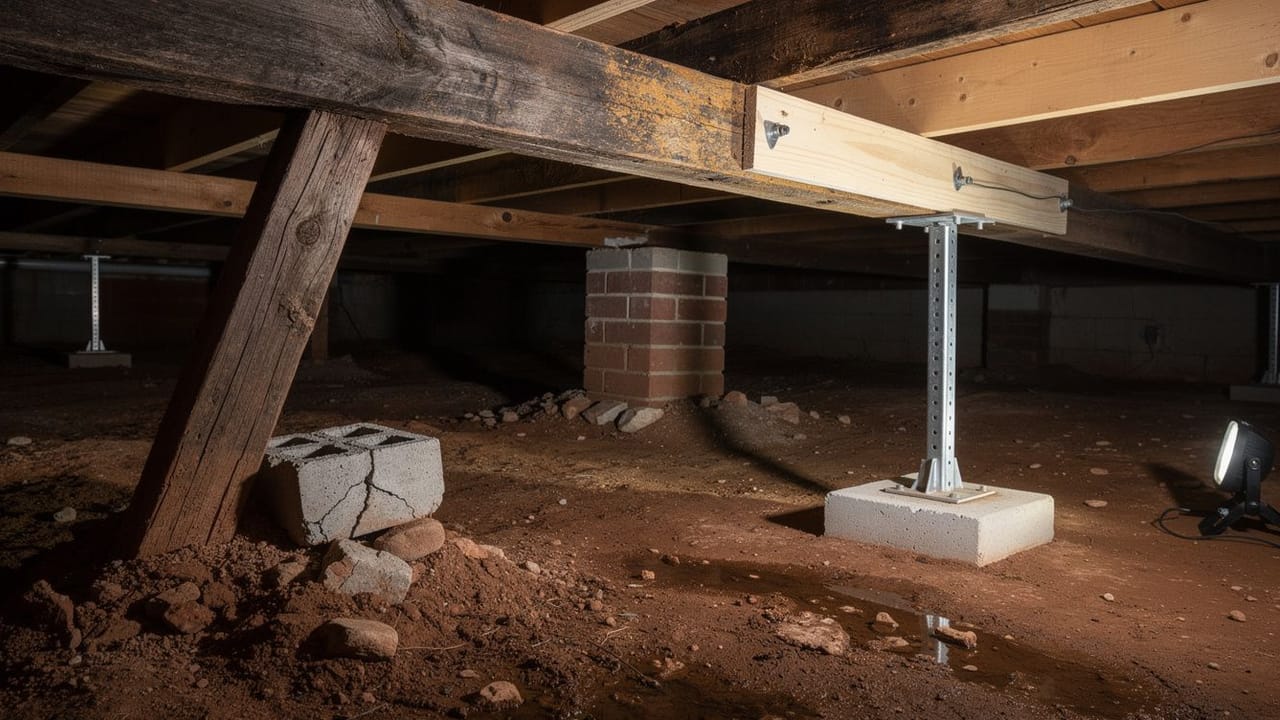
When we crawl under a floor that moves, we check three things first: whether the support posts have sunk, and what each one is standing on, be it a concrete footing, a stack of loose block or bare dirt; whether a girder dips between its posts; and whether the joists have gone soft. That last one is as much a moisture problem as a structural one. The Building America Solution Center’s guide on capillary breaks for crawlspace floors says moisture in a crawl space promotes mold and rot along floor joists and rim joists, and the EPA’s course on mold basics and moisture control notes that molds can weaken floors by feeding on wet wood.
Old plumbing and HVAC work is the other place we look. A joist that was notched or drilled to get a drain line or a duct through has lost wood where the cut is, so we note how deep each cut runs and where it sits along the joist, and we follow every pipe and duct run to find the ones nobody mentioned.
Reading the symptom
We treat what you feel upstairs as a first guess about where to look, and the crawl space decides it. Bounce sends us to the joists, their span and their condition. A slope sends us to whatever holds up that part of the floor. When a floor does both, we start at the girder line beneath it.
Whether it is getting worse counts for as much as which way it leans. A level and a tape across the same few points, written down with the date each time, will show whether a floor is holding still or still moving, and it gives us better evidence than memory when we inspect the crawl space. We also take moisture readings in the wood itself; the Building America guide to water management in an existing crawlspace lists testing the moisture content of the rim and floor joists among its checks after a crawl space retrofit, and we take the same reading before one.
- Bounce: we look at joist span and joist condition
- Slope toward the middle: we check the girder and the posts under it
- Slope toward an outside wall: we check the foundation wall and its footing
- A soft spot in one place: we look for rot, starting under any bath or kitchen above it
- Notched or drilled joists: we follow the plumbing and duct runs
How is a sagging floor repaired?
Where a timber post has sunk, we replace it with an adjustable steel post on a new concrete footing. A joist that has softened, or been cut too deep, gets a new one sistered alongside it. Where a girder sags between posts, we add an intermediate support line under it to shorten the span. In Metro Nashville we build to the 2024 International Residential Code, the edition Metro Codes lists as adopted with local amendments, and in the surrounding counties we confirm what the local building department has adopted before we start.
We lift slowly, a little at a time over days or weeks, so the drywall, trim, doors and pipes above have time to move with the floor. A house that settled over decades is not something we try to undo in an afternoon.
Fix the moisture as well
Shoring up the structure without dealing with the damp that softened it leaves the cause in place. The Building America water management guide is blunt that building materials left damp or saturated for long periods will eventually fail, and it deals with the outside first: ground regraded to slope away from the house, drain pipe around the footings, and gutters and downspouts that carry rain clear of the foundation. A new sistered joist sits in the same air as the one it is propping up.
So a repair quote should say how the moisture and the ground cover will be handled, even when the answer is that they already are. The Building America ground cover guide calls for every crawlspace to have polyethylene sheeting of at least 6 mil over the ground, seams lapped and sealed, run up the walls and piers. Some houses need more than a sheet on the dirt, which is where our encapsulation work comes in, and why a crawl space gets wet in summer explains where that damp comes from. To have someone look at the floor and what is holding it up, ask us for a free estimate.
Sources
- DOE Building America Solution Center, Capillary Break in Crawlspace Floors: Polyethylene Lapped up Walls and Piers or Secured — Moisture promotes mold and rot along floor and rim joists; every crawlspace should have a polyethylene ground cover of at least 6 mil, seams lapped and sealed, run up walls and piers
- U.S. EPA, Mold Course Chapter 2: Mold Basics — Molds can weaken floors by feeding on wet wood; consult a structural engineer or other professional when mold may have damaged the structure (named in the cost FAQ)
- DOE Building America Solution Center, Water Management for Existing Crawlspace Floor — Materials left damp or saturated will eventually fail; regrading, footing drains and gutters to keep bulk water out; test the moisture content of the rim and floor joists after a retrofit
- Metro Nashville Codes, Adopted Codes List — Metro has adopted the 2024 International Residential Code with local amendments
FAQ
Sagging Floors and What Is Under Them — questions
Is a bouncy floor dangerous?
A bounce on its own can come from joists that are simply long for their size, with nothing failing, but only a look underneath can say which. Two things we would not wait on: a soft spot in one place, which can mean rot in the joists or the subfloor, and a floor that has changed noticeably in a short time. Both are worth having looked at from below.
Can sagging floors be lifted back to level?
Some of the way, at least. We lift slowly, over days or weeks, and we stop when the floor is close enough instead of forcing it dead level. In an older house the walls, doors and trim may have settled along with the floor, and we would rather leave a slight slope than crack what has adjusted to it.
How much does crawl space structural repair cost?
It depends on what is found. A couple of posts on new footings is a far smaller job than replacing joists along a girder line with the moisture work done alongside it, so we look under the house before we quote. Where mold or rot in the wood may have damaged the structure, the EPA mold course advises consulting a structural engineer or another professional with the relevant expertise, and that assessment is worth having before you collect quotes.
How do you repair a rotted floor joist?
We sister a new joist alongside the softened one and fix the damp that rotted it, since new wood in the same wet air heads the same way. That means checking the grading, gutters and footing drains outside and covering the ground with sealed 6-mil polyethylene. Where rot may have hurt the structure, EPA suggests a structural engineer.