
· by Michael Blair, Nashville's Crawl Space Repair
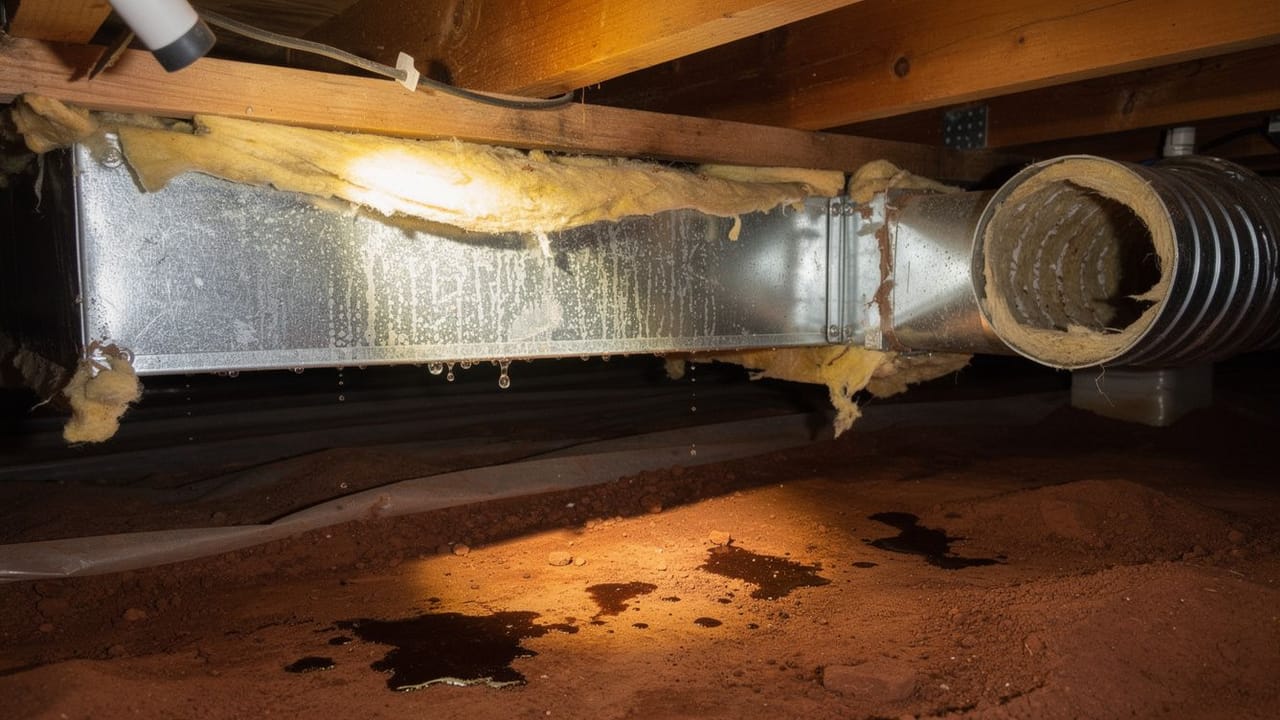
In July the ducts under a house can drip like a glass of iced tea. The water lands on the ground cover or the dirt, soaks the insulation between the joists, and keeps the crawl space damp all summer. Owners often take it for a plumbing leak, or for a sign the air conditioner is failing. It is usually neither. Here is why a duct sweats, what the residential code asks of ductwork in a crawl space, and how we stop it from dripping.
Why is the ductwork under my house sweating?
Ductwork sweats when the air around it is warm and humid and the duct surface is colder than that air’s dew point, so moisture condenses on the metal the way it does on a cold drink. During the cooling season the supply ducts carry air straight off the air conditioner’s coil, and a vented crawl space in a Middle Tennessee summer is full of outdoor air that is close to saturated. The EPA’s mold course, Chapter 2, shows condensation on an uninsulated air conditioning duct, and its fix is to insulate the duct on the outside.
Bare metal is the obvious case, but insulated ducts sweat too, and those are the ones we find most often. The Building America Solution Center’s guide to sealed and insulated flex ducts says duct sweating can become a significant problem in humid climates where the thermal barrier and the vapor barrier are not aligned along the duct. Humid air slips past a torn jacket or an open seam, reaches the cold inner duct, and condenses inside the insulation, where nobody sees it until it drips.
What does the code require for ducts in a crawl space?
The code requires ducts in a crawl space to be insulated and sealed unless they sit completely inside the building’s thermal envelope. In the 2018 International Residential Code as published for Tennessee, Section N1103.3.1, supply and return ducts outside the attic need at least R-6 where they are 3 inches across or larger and R-4.2 below that, while attic ducts need R-8. Section N1103.3.2 adds that ducts, air handlers and filter boxes must be sealed.
A code minimum is not the same as a dry duct. The Building America guide calls for at least R-8 on supply ducts, a vapor barrier on any duct in unconditioned space, and insulation without gaps, voids or compression. It warns that tight straps and framing pressing on a duct crush the insulation and leave cold spots where condensation forms, and it calls for UL-181 foil tape on the outer liner rather than cloth duct tape, which dries out and fails.
The exception matters as well. Ducts entirely inside the thermal envelope need no insulation under that section, which is one reason a crawl space that is sealed, insulated at its walls and kept dry changes the picture, as our encapsulation page explains.
How do you stop ducts from sweating in a crawl space?
You stop ducts from sweating by keeping humid air off the cold surface: seal the duct, repair the insulation and its vapor jacket, then lower the humidity of the air around it. Wrapping only the spots that drip does not work, because a gap a few feet away keeps feeding water into the insulation.
We start by walking every run with a light. Duct joints are sealed first, so cold air is not leaking into the insulation from inside. Torn flex jackets are re-covered and taped, slipped wrap on metal trunks is replaced and its seams taped, and crushed sections are rehung on wide straps. Wet insulation comes off rather than being wrapped over, since it holds water against the metal. Our insulation and air sealing page covers that work.
The second half is the air. In a vented crawl the duct sits in summer air whatever we do to it, so the jacket has to be continuous for the duct to stay dry. In a sealed crawl with a dehumidifier, the air around the duct holds less water and the margin is wider. Our post on crawl space vents, open, closed or sealed covers that choice.
Is the water condensation or something else?
Most summer water dripping from duct lines under a house is condensation, but two other sources look the same, so we rule them out before insulating anything. One is the air conditioner’s own condensate drain, which can come apart, crack or clog and empty straight into the crawl space. The other is a plumbing leak above, running along a duct before it falls.
Condensation follows the weather and the thermostat. It shows up on humid days while the system is cooling, is heaviest on the supply side near the air handler, and stops in the fall. A drain or plumbing leak keeps going regardless and usually leaves one wet spot rather than a line of drips. Whichever it is, a season of water on the floor insulation and the ground needs drying out, which is the moisture control side of what we do. If your ducts are dripping, have us look under the house.
Sources
- U.S. EPA, Mold Course Chapter 2: Why and Where Mold Grows — Condensation forms when warm, humid air meets a cold surface; condensation on an uninsulated air conditioning duct, fixed by insulating the duct on the outside; ducts in non-air-conditioned spaces sealed and insulated.
- U.S. Department of Energy, Building America Solution Center (PNNL), Sealed and Insulated Flex Ducts — Vapor barrier required on ducts in unconditioned space; duct sweating in humid climates when thermal and vapor barriers are misaligned; compression causes cold spots and condensation; UL-181 foil tape, not cloth duct tape; R-8 supply, R-6 other ducts.
- 2018 International Residential Code as published for Tennessee, Sections N1103.3.1 and N1103.3.2 (UpCodes) — Duct insulation R-8 in attics and R-6 elsewhere for ducts 3 inches and larger (R-6 and R-4.2 below 3 inches); exception for ducts inside the thermal envelope; ducts, air handlers and filter boxes sealed.
FAQ
Why Ductwork Sweats in a Crawl Space — questions
Why is my AC duct dripping water under the house?
Because the duct is colder than the dew point of the crawl space air around it. Air leaving the cooling coil runs through the supply ducts, and humid summer air that reaches the metal condenses on it. On an insulated duct, dripping usually means the vapor jacket is torn, open at a seam or crushed somewhere along the run.
What R-value should crawl space ductwork have?
The 2018 International Residential Code for Tennessee, Section N1103.3.1, asks for at least R-6 on supply and return ducts 3 inches or larger outside the attic, and R-4.2 on smaller ones. The Building America Solution Center calls for R-8 on supply ducts, always with a continuous vapor barrier in unconditioned space.
Can sweating ducts cause mold in a crawl space?
Yes. Condensation dripping through a whole cooling season wets the floor insulation, the joists it touches and the ground cover below, and EPA’s mold course names condensation on cold surfaces as a common moisture source. The fix is to stop the water first, then dry and clean what it reached, not to treat the mold alone.
Do ducts sweat in an encapsulated crawl space?
Less often, but they can. A sealed crawl space with a working dehumidifier keeps the air around the ducts drier, so their surfaces are less likely to fall below its dew point. Bare metal, open seams and torn jackets can still sweat if the humidity climbs, which is why we check the ducts during encapsulation.
Can I just wrap sweating ducts in more insulation?
Not over wet or torn insulation. Wrapping a damp duct traps the water against it, and a new layer without a sealed vapor jacket lets humid air reach the cold metal again. Remove what is wet, seal the duct joints, then insulate with a continuous jacket taped with UL-181 foil tape, without crushing it.