
· by Michael Blair, Nashville's Crawl Space Repair
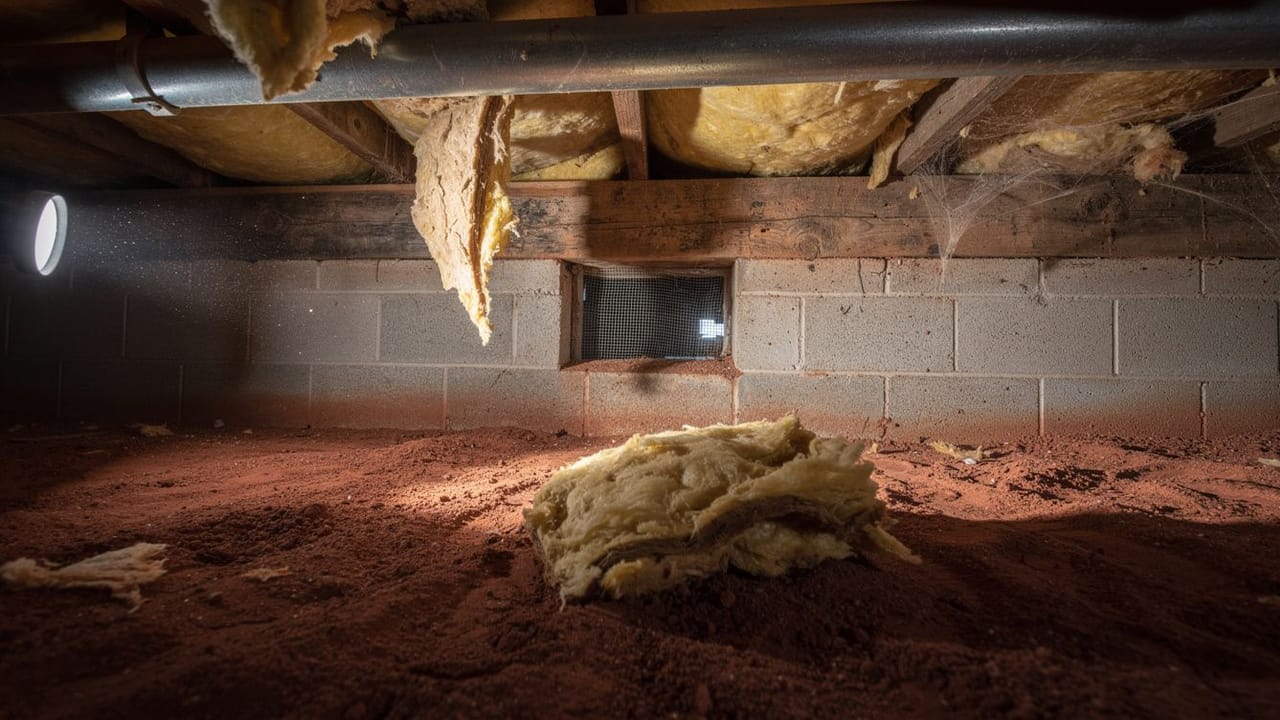
Fiberglass batts pushed up between the floor joists are a familiar sight when we open the access door on an older house, and so are the ones hanging loose or lying on the dirt. The Building America Solution Center’s guide to insulating the floor over a vented crawlspace says plainly that batts without wire stays or metal support rods will not stay aligned with the subfloor, and that batt insulation is not a good air barrier in the first place. How they were held up is half the story. The other half is the damp air they have been sitting in.
Why batts fail here
A vented crawl breathes outside air, and in a humid summer that works against you: the Department of Energy’s guide to unvented, insulated crawlspaces explains that in humid climates the vents can encourage condensation by letting warm, moist air in to condense on joists cooled by the air conditioning above. The EPA’s mold course adds that humid crawl spaces are common sites of hidden mold, particularly over a bare earth floor, since the soil wicks moisture up. Batts stapled into that space spend every summer in it, which is why our post on wet summer crawl spaces starts with the air rather than the insulation.
Pests are the other reason old batts rarely go back up. The same DOE guide notes that sealed, insulated crawlspaces are less likely to harbor pests, and when we pull batts out of a vented crawl we check them for droppings and tunnels. Our post on what lives in a Nashville crawl space covers who usually leaves them.
Where does insulation go in an encapsulated crawl?
Once the crawl is sealed, the thermal boundary moves from the floor above down to the foundation walls. The DOE guide to unvented crawlspaces puts unfaced rigid foam board against the interior perimeter walls, recommends polyisocyanurate or XPS for its low permeance and high R-value per inch, and says no insulation is needed in the crawlspace ceiling. It pairs the foam with 6-mil polyethylene over the floor and lapped up the walls, a drying mechanism such as a small conditioned-air supply, which the 2009 IRC it quotes requires, and a radon vent under the vapor barrier. That combination is what our encapsulation work installs.
With the walls insulated, insulating the floor as well is redundant, so the old batts come out. Water comes first, though. The Building America guide to insulating crawl space floors is clear that any moisture problem in the crawl or around the foundation must be taken care of before insulation goes in, and that is the order we work in.
- Find and fix the water before any insulation goes in
- Remove wet or fallen batts; we do not re-hang them
- Rigid foam on the perimeter walls after encapsulation
- Seal the rim joist, and insulate it where the wood can still dry
- Mastic-seal and insulate any ductwork in the crawl
- Keep pipes and ducts inside the insulated walls, out of the winter air
Why does the rim joist matter so much?
The band of framing that sits on top of the foundation, where the floor structure meets the wall, is on ENERGY STAR’s list of common air leaks in basements and crawlspaces, between the rim joists and under the sill plate. The Building America guide to rigid foam on existing band joists calls air sealing and insulating band joists important in every climate zone, and it is one of the first places we put a light on when we go under a house.
Rigid foam cut to fit and caulked or foamed at the edges, or spray foam on its own, seals and insulates it in one pass. Two cautions come from the same DOE guides. If there is any doubt that the band joist can dry, the unvented-crawlspace guide says the safest practice is to leave it uninsulated so the wood dries freely. And most codes want a thermal or ignition barrier over foam plastic, so we confirm what the local code asks for before the foam goes up. Our insulation and air sealing service is where this work sits.
Ducts in the crawl
If your heating and cooling ducts run through the crawl, a leaking joint or a bare run in a vented space pours air you paid to condition into a place you are not trying to condition. Sealing the crawl changes that: the DOE’s unvented-crawlspace guide describes the sealed, insulated crawl as a clean, dry location to house the main floor heating ducts, and it brings the pipes inside the insulated walls as well.
For the ducts themselves, the Building America guide to encapsulated ducts, written for attic runs, calls for every connection to be mechanically fastened and sealed with mastic, R-8 or better insulation with a vapor barrier cover, and a duct leakage test. We hold crawl ductwork to the same standard. If you would like us to look at yours along with the batts and the rim joist, ask us for a free estimate.
Sources
- DOE Building America Solution Center, Floor Above Unconditioned Basement or Vented Crawlspace — Batts need wire stays or support rods to stay aligned; batts are not a good air barrier; rim joists sealed with rigid foam or spray foam; closed-cell foam at 1.5 inches serves as an air barrier
- DOE Building America Solution Center, Unvented, Insulated Crawlspaces — Vents encourage condensation in humid climates; sealed crawls less likely to harbor pests; rigid foam on perimeter walls, none in the ceiling; 6-mil vapor retarder, drying mechanism (2009 IRC R408.3), radon vent; band joist drying caution; ducts housed in the sealed crawl
- US EPA, Mold Course Chapter 2 — Humid crawl spaces are common sites of hidden mold, particularly over a bare earth floor
- DOE Building America Solution Center, Insulating Crawl Space Floors in Existing Homes — Moisture problems must be taken care of before insulating; closed-cell floor assembly not suited to a crawl accessed often
- ENERGY STAR, Basement and Crawlspace sealing — Rim joists and the sill plate listed among common crawlspace air leaks
- DOE Building America Solution Center, Rigid Foam Board Insulation for Existing Band Joists — Air sealing and insulating band joists important in all climate zones; most codes require a thermal or ignition barrier over foam plastic
- DOE Building America Solution Center, Encapsulated Ducts — Duct connections mechanically fastened and mastic-sealed; R-8 or higher duct insulation; duct leakage testing
FAQ
Why Crawl Space Insulation Falls Down — questions
Should I re-fix insulation that has fallen down?
Not until you know why it fell. Batts held up without wire stays or support rods sag on their own, and batts in a damp vented crawl sit in humid air all summer. We take fallen batts out, find out why the crawl is damp, and insulate the walls once the space is encapsulated. In a crawl that stays vented and dry, new batts held tight to the subfloor with proper supports can work.
Is spray foam a good choice under the house?
Closed-cell foam at the rim joist and on the walls seals and insulates in one step, and at an inch and a half or more it can serve as the air barrier. The caveats are that it makes the wood beneath hard to inspect later, that it must not be applied over framing that is already damp, and that most codes want a thermal or ignition barrier over foam plastic. It is a good product applied at the right stage.
Do I insulate the floor or the walls?
Whichever side the thermal boundary is on. A vented crawl space insulates the floor above; an encapsulated crawl insulates the perimeter walls, because the crawl is now inside the boundary and no insulation is needed in its ceiling. Doing both is redundant.
Does crawl space insulation need a vapor barrier?
In an encapsulated crawl, the vapor retarder goes on the ground rather than on the insulation. The Department of Energy’s guide pairs rigid foam on the perimeter walls with 6-mil polyethylene over the floor and lapped up the walls, plus a way to dry the air. Batts under the floor make a poor air barrier either way.