
· by Michael Blair, Nashville's Crawl Space Repair
Pests end up in a crawl space for the same few reasons. UT Extension’s guide to managing pests around the home names light, warm air, moisture and food as what draws them, and says they look for shelter in dark cavities in walls and crawl spaces. Termites need the damp, mice and rats want the cover, and a damp vented crawl in Middle Tennessee gives termites in particular what they are after. When we inspect a crawl space, whatever is living down there goes in the report along with the conditions that brought it.
Which crawl space pest does the most damage?
Subterranean termites are the most destructive wood-feeding insects in Tennessee, according to UT Extension’s publication on subterranean termite control. The workers are soft-bodied and dry out quickly, so they keep in contact with the soil for moisture, and the colony comes into a house through wood or foundation walls that touch the ground. Mud tubes running up piers or foundation walls are the sign we look for first. The University of Kentucky’s termite fact sheet describes them as pencil-wide and lists winged swarmers, or the wings they shed on windowsills and along floor edges, as the other giveaway.
Wood touching soil, form boards and scraps left under the house after construction, and damp framing all raise the risk. UT says to pull form boards and wood scraps out of the soil, and it warns that humid pockets of dead air under a house are conducive to termite activity. Kentucky’s sheet wants wood siding and door and window frames at least six inches above the ground. We check that clearance on every visit, along with soil or mulch piled against the foundation; UT asks for a strip 12 to 18 inches wide next to the foundation kept free of plants and mulch.
Rodents
Mice and rats get in around pipe and wire penetrations, under doors and through vents with damaged or missing screens. Kentucky’s guide to pest-proofing a home calls for 1/4-inch hardware cloth over crawl space vents and for sealing the openings where pipes and wires enter the foundation. A mouse needs very little room: UK’s fact sheet on controlling mice says they squeeze through gaps narrower than a dime and that foundation cracks 1/4 inch and wider should be sealed. We look at the rim joist too, where the framing sits on the foundation, and sealing it is part of our insulation and air sealing work. The signs to look for, per EPA’s page on identifying rodent infestations, are droppings, holes chewed through walls and floors, and nesting material such as shredded paper, fabric or dried plant matter.
Trapping clears out the animals already down there, and sealing keeps the next ones from following. Kentucky’s entomologists say the best way to control mice is to keep them from getting in, and EPA’s page on dealing with rodents warns that a rodent released outside may find its way back unless the entry points are sealed. A plastic liner on the ground stops nothing by itself. Encapsulation helps with rodents only where the vents and penetrations are closed as part of the job, which is why sealed vents are part of our encapsulation work.
- Mud tubes on piers: termites, act promptly
- Droppings, gnaw holes and nesting material: rodents
- No soil-to-wood contact anywhere
- Remove construction debris and stored wood
- Screen and seal every vent and penetration
What do crickets and springtails in a crawl mean?
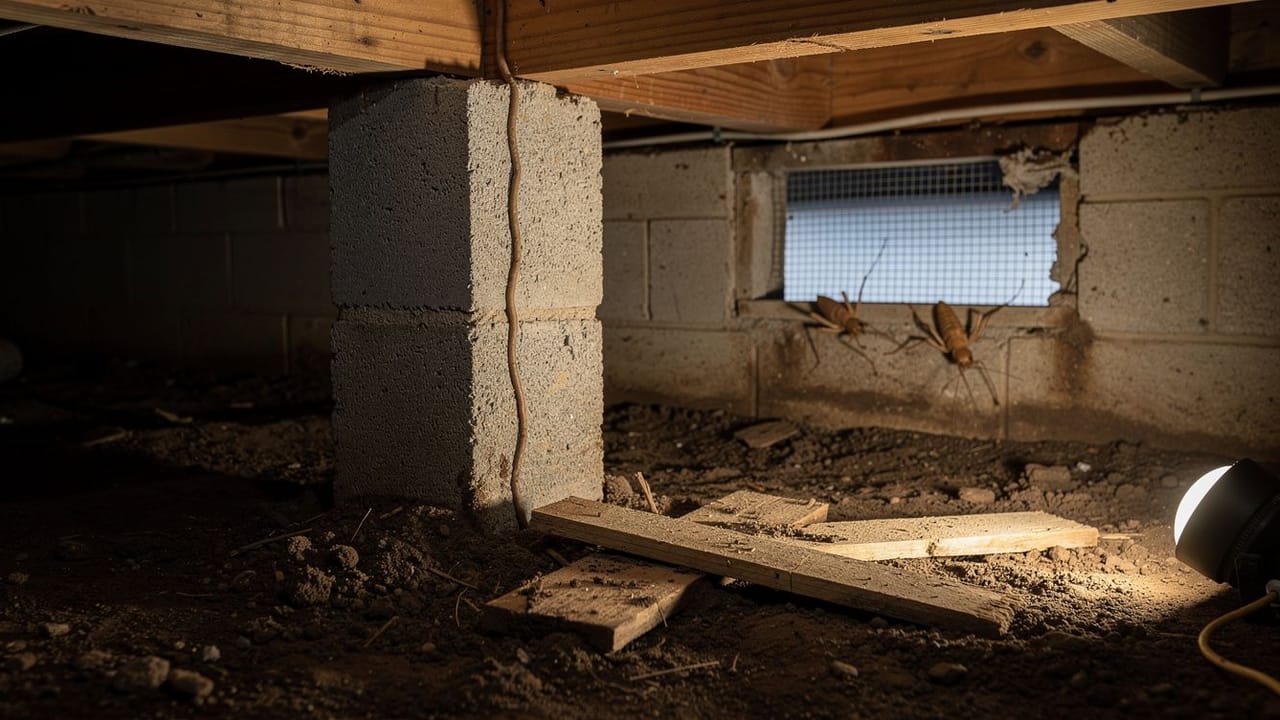
Camel crickets, springtails, millipedes and centipedes in numbers usually say more about the humidity than about a pest problem of their own. Clemson Extension’s camel cricket fact sheet calls moisture an important requirement for their survival and finds them indoors in damp basements, crawl spaces and garages. Its fact sheet on springtails ties their invasions to excess moisture, and Kentucky’s sheet on centipedes and millipedes associates both with damp, moist areas.
Drying the crawl takes away the habitat, and that lasts longer than treating over and over for insects that return while the conditions stay the same. Clemson says cutting down moist habitat is essential for long-term camel cricket control, and that sprays for springtails give temporary control unless the moisture is corrected. Kentucky adds that most millipedes and centipedes die soon after getting inside a house because it is too dry for them. Bringing the humidity down is our moisture and dehumidification work, and the reasons a crawl stays wet through a Nashville summer are in our post on crawl space humidity.
Encapsulation and inspection
A dry, sealed crawl takes away the damp the crickets, springtails and millipedes depend on and the humid air UT links to termite activity, but it is not a termite treatment. UT’s publication covers soil treatment and baits as the ways to control termites, with wood treatment only as a supplement, and it says a professional should inspect at least once a year. That inspection has to stay possible after the work. The Department of Energy’s Building America guide to unvented, insulated crawlspaces says to leave a pest control inspection strip of bare wall where local codes require one, 3 inches of it in termite-prone areas, and to ask the building inspector or a pest control professional what applies locally. Liner or foam board run the full height of the wall covers exactly the place an inspector looks for mud tubes.
Talk to your termite provider before the crawl is encapsulated, so the liner and any wall insulation are detailed to leave that strip open. If you are still deciding, our post on whether encapsulation is worth the cost goes through it, and you can ask us for a free estimate.
Sources
- UT Extension, PB1303 Managing Pests Around the Home (2002) — Pests are attracted by light, warm air, moisture and food; pests seek shelter in dark cavities in walls or crawl spaces
- UT Extension, PB1344 Subterranean Termite Control (2001) — Most destructive wood-feeding insects in Tennessee; workers need soil contact for moisture; colonies enter through wood or foundation walls adjacent to soil; remove form boards and wood scraps; humid dead-air pockets conducive to termites; 12 to 18 inch plant and mulch free zone; soil treatment and baits, wood treatment as a supplement; annual professional inspection
- University of Kentucky Entomology, ENTFACT-605 Protecting Your Home Against Termites — Pencil-wide mud tubes on foundations and piers; swarmers and shed wings; wood at least six inches above ground
- University of Kentucky Entomology, ENTFACT-641 How to Pest-Proof Your Home — 1/4-inch hardware cloth over crawl space vents; seal openings where pipes and wires enter the foundation
- University of Kentucky Entomology, ENTFACT-617 Control of Mice — Prevent entry as the best control; openings narrower than a dime; seal foundation cracks 1/4 inch and larger and gaps under doors
- U.S. EPA, Identify and Prevent Rodent Infestations — Signs: droppings, chewed holes, nesting material such as shredded paper, fabric or dried plant matter
- U.S. EPA, Options to Deal With Rodent Infestations — Released rodents may return unless entry points are sealed
- Clemson Cooperative Extension, HGIC 2405 Camel Crickets — Moisture required for survival; found in damp basements, crawl spaces and garages; reducing moist habitat essential for long-term control; mostly a nuisance, can damage fabrics and houseplants; outdoor chemical control if habitat changes are not enough; humpbacked, wingless adults
- Clemson Cooperative Extension, HGIC 2445 Springtails — Indoor invasions tied to excess moisture; sprays give temporary control unless moisture is reduced
- University of Kentucky Entomology, ENTFACT-645 Centipedes and Millipedes in and Around the Home — Associated with damp, moist areas; most die soon after entering a structure for lack of moisture
- U.S. Department of Energy, Building America Solution Center: Unvented, Insulated Crawlspaces — Leave a pest control inspection strip where local codes require; 3 inches of bare wall in termite-prone areas; check local requirements with the building inspector or a pest control professional
FAQ
What Lives in a Nashville Crawl Space — questions
Does encapsulation stop termites?
No. It takes away damp conditions termites favor, but it is not a termite treatment and should not be sold as one. UT Extension says subterranean termites live in the soil and come in through wood or foundation walls that touch it, and a liner does not change that. Keep a termite agreement and the yearly inspection in place, and talk to the provider before the work so the barrier leaves a bare inspection strip on the foundation wall.
What are the crickets in my crawl space?
If they are humpbacked and wingless with very long legs and antennae, they are camel crickets, which Clemson Extension finds indoors in damp basements, crawl spaces and garages. Clemson calls them mostly a nuisance, though in large numbers they can damage fine fabrics and houseplants. A lot of them is a reliable hint that the crawl is humid. Drying it out removes the habitat, which does more over time than repeated spraying, though Clemson notes an outdoor treatment around the house may still be needed if they persist.
How do rodents get into a crawl space?
Around pipe and wire penetrations, under doors, through vents without sound 1/4-inch screening and through foundation cracks, and we check the rim joist as well. A mouse can get through a gap narrower than a dime. Trapping removes the ones already inside, but the openings have to be sealed or new ones follow. Encapsulation only helps here when the vents and penetrations are sealed as part of the job.
How do I check for termites in my crawl space?
Look for pencil-wide mud tubes running up the piers and foundation walls, and for winged swarmers or the wings they shed on windowsills and along floor edges. Check for wood touching the soil and scraps left under the house after building. UT Extension says a professional should inspect at least once a year.